India has seen a cataclysmic coronavirus surge over the past week, reporting more than 300,000 new coronavirus cases per day, with the real figure probably higher. The spike in infections has led to deadly shortages of oxygen, ambulances and hospital beds. Countries around the world have pledged to send aid in the form of medical supplies and vaccine doses, but urgent requests for ventilators and intensive care unit beds continue to flood social media.
As India’s health-care system buckles under pressure, here are some organizations that are providing relief.
• UNICEF
The United Nations agency is providing supplies including oxygen concentrators, coronavirus test kits and personal protective equipment to health care facilities. UNICEF’s Mumbai office has also helped to ensure that public bathrooms in densely populated neighborhoods are regularly sanitized, and the organization has installed elbow-operated faucets and promoted hand-washing in schools. Donate here.
• The Indian Red Cross
India’s branch of the international humanitarian aid organization is providing ambulance transportation and oxygen in hard-hit cities such as Delhi and Mumbai, and helping to administer vaccine doses. Volunteers are handing out masks, food and hygiene supplies in both rural and urban areas. Donate here.
• Rapid Response
The India-based disaster relief agency is supplying staple foods such as rice, lentils, sugar and salt to vulnerable communities including migrant laborers, front-line workers and the elderly. Donate here.
• American Association of Physicians of Indian Origin
The professional association is collecting donations that will be used to purchase oxygen concentrators and send them to India. Donate here to cover the costs a single machine, which costs $500, or here to contribute to the group’s efforts.
• Hope Foundation
The Irish nongovernmental organization provides health services to street children in Kolkata and has been converting its wards to treat coronavirus patients. Currently, all three covid-19 wards are full, and the group hopes to raise funds to open another. Donate here.
• Oxfam India
In addition to distributing protective equipment at health facilities, the nonprofit says it intends to make direct cash transfers to the most vulnerable households. Donate here.
I don’t know exactly how or why, but you work. And more than just occasionally, you totally rock it! Here are some random cases in point (along with some random pictures):
Getting things done: I was staying overnight at a friend’s house and I casually commented that I needed to get my hair cut. She took out her phone (it was 9:00 p.m.) and called her neighbour, a beautician. Could she come over to give me a haircut? Why yes, she could, and by 9:45, I had a new haircut. Truth to tell, I was thinking, “Well, this might not turn out to be a very good haircut, but whatevs, it’ll grow out.” But guess what? It was a good haircut! Many things in India are quite easy to do, because there is so much labor out there. It’s generally a matter of a phone call to get an electrician, construction worker, gardener, etc., to come and take care of whatever household task you may have. And they will come soon – not in two weeks “sometime between the hours of 10:00 and 4:00”! On the flip side, labor is very cheap and the result is that for many people it is probably difficult to make a real living wage.
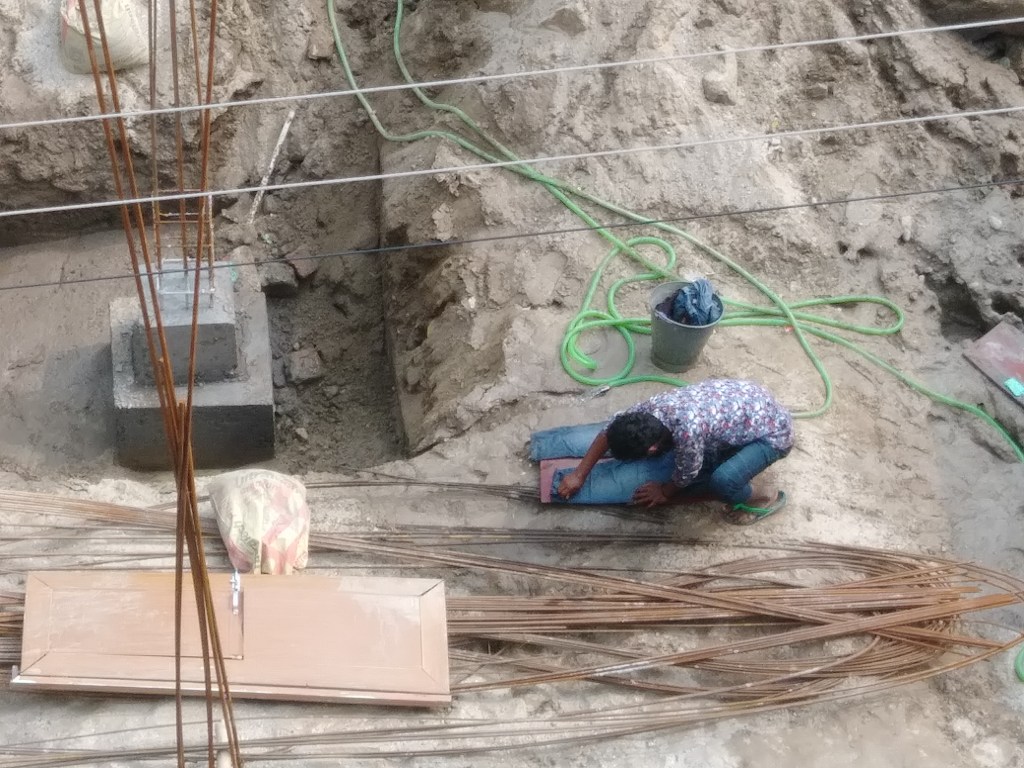
Seen from my window: This young man is washing his jeans at the construction site right next to my flat. Over the past month, next to my flat a concrete and brick building has come down, brick by brick, the site levelled, and construction begun on a new building. The process has been endlessly fascinating — with few exceptions, it has proceeded entirely without power tools or heavy equipment. A backhoe was brought in for one night to level the ground, and an electric saw was used to cut the rebar. Other than that, everything but everything has been done solely relying on human power. It is extremely labor intensive. And yay! young man, for washing your own jeans.
Closeness: There’s a different sense of closeness here. People need and want to be in close proximity to one another. Relatedly, it is rare to see an outdoor scene in which there is not at least one person – in fact, many people! When I get up in the morning, usually around 6:30 or so, I go out to my balcony and look down at the street scene below to see how many people I can see. I can usually count around 15-20 people, some walking, some sitting around chatting, some doing this-and-that, who-knows-what. If I do the same thing from my front porch at home, I will wait 45 minutes before someone wanders by, usually walking their dog, or a bit later, kids on their way to school. In American society the individual is so much more isolated. That’s not news to anyone, but it is interesting to see the differences in action. There is actually something kind of lovely about being packed cheek by jowl into the back of a car or in a toto, or sitting in a group to chat where people in the group are sitting very close to one another. Though I’m pretty far to the introversion side of the spectrum, I have enjoyed both observing and being part of that closeness. It is nice to see, for example, two male friends sitting with their arms around one another, or walking hand in hand. Or to see 20 year old young men reaching out to hold and play with babies, babies who get passed around in a group as a matter of course.
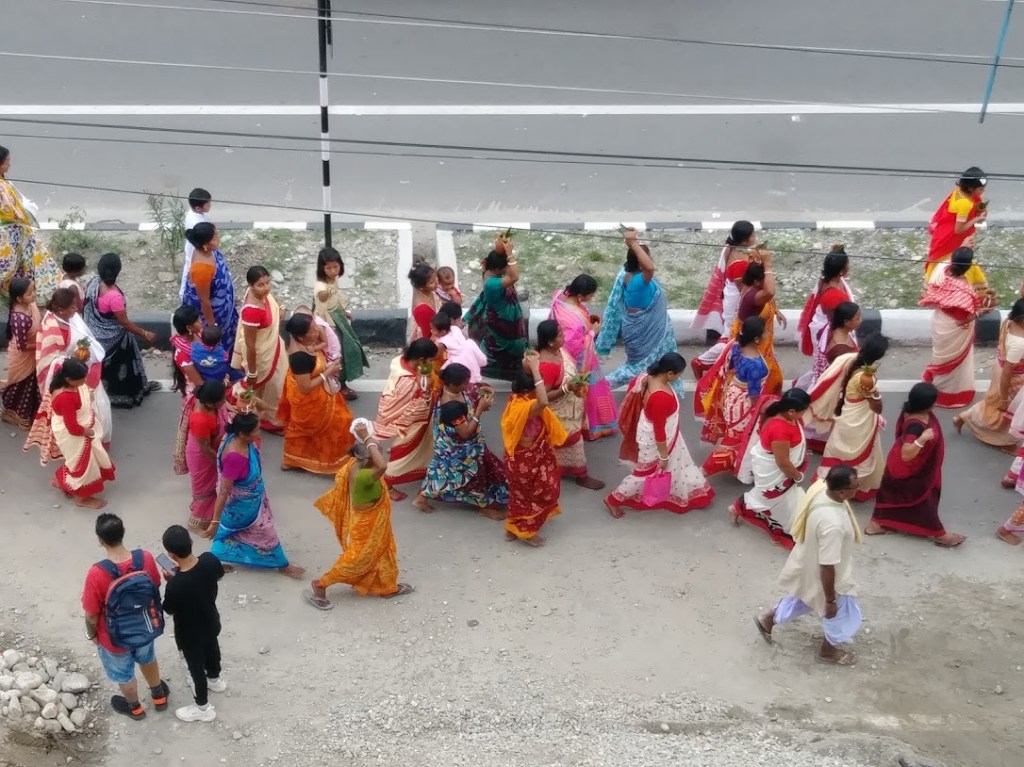
From my balcony: This is part of a wedding parade or procession, a part of the many festivities and traditions that precede the marriage ceremony. This particular one was quite long — they are always loud, with music broadcast from a loudspeaker affixed to a toto. Some of the women are carrying pots of water, the water is used in part of the ceremonies that accompany the wedding.
Young people: Young people here, at least those whom I’ve interacted with at NBU, are phenomenal – smart, energetic, hard-working. Give them opportunity, meaningful and decent-paying jobs, and they’ll take off and so will India. It seems to me they are poised in the balance now, poised between hope and resignation (I won’t say “despair”). If the government or economy can help tip the balance toward hope, and they have the chance to do their thing, (i.e., they don’t have to come to America to do it there, although I’d be delighted to have them and they can all stay at my house!) then it seems like India will be set to move ahead into the future. I have a sense that it may take a new generation of political leaders, politicians who have not been jaded by endemic corruption and are using their political clout primarily as a way to line their pockets.
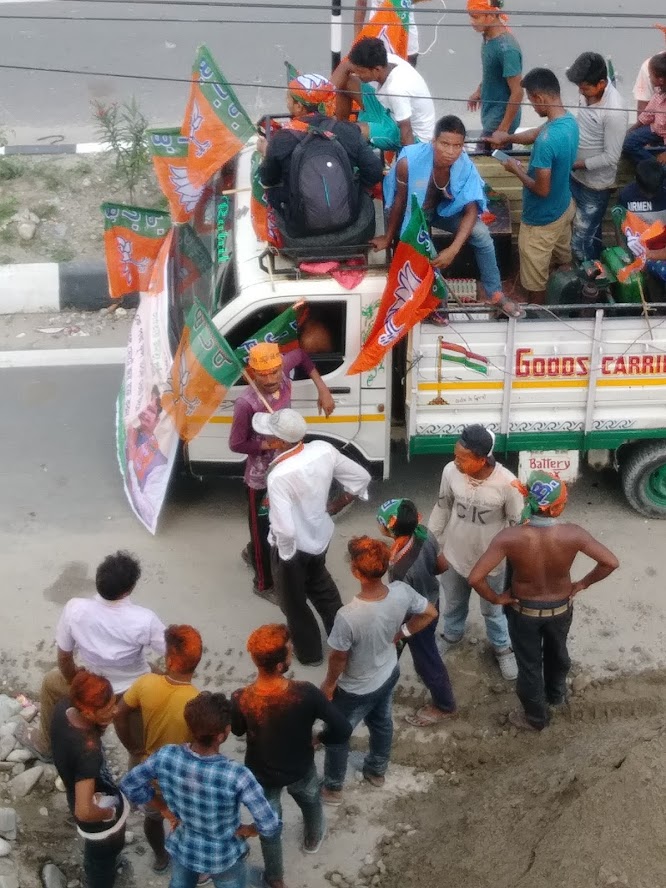
Also from my balcony: Part of a BJP victory celebration that took place a few days after the election results were tallied, showing a huge victory for P.M. Modi and his Bharatiya Janata Party. Following the truck was a long parade of celebrants. You might notice that everyone in the picture is male. There were women in the group, but generally the public space is dominated by men, a phenomenon much more noticeable in North India than in West Bengal (which is actually eastern India).
Patience: People here tend to be incredibly patient, which is a great quality, though it can also be “too much of a good thing”. For example, at a level crossing (a RR crossing) the barrier comes down at least several minutes before the train passes. All traffic, a mixture of cycle rickshaws, totos, trucks, cars, buses, comes to a stop. (Pedestrians and bicyclists usually scoot under the barrier and cross before the train comes – even I did that once, but of course, my heart was in my throat even though the train was nowhere to be seen or heard!) Everyone sits and waits patiently for the barrier to rise. This can take as long as five minutes. I just don’t see the same thing happening in the US – drivers would be very anxious to get moving — I’ve seen cars rev up and reverse out of traffic while waiting at the RR crossing at Ruston Way, for example.
My students offer another example, which to me shows the “too much of a good thing” side of patience. As I’ve written elsewhere, classes rarely seem to start on time. This means that students are missing out on class time (although maybe other teachers extend their class times to compensate, I’m not 100% sure). And they patiently accept this – while to my way of thinking, they should complain and make sure their classes start on time! (Of course, I also recognize that students the world over are probably only too happy when class is cut short – it is just my fantasy that they hang on the professor’s every precious word.) I think I have become more patient during my time here, and patience has never been my strong suit. I’ve realized so often that there is just absolutely nothing I can do about _______ (fill in the blank with any number of challenging situations). I wonder if it will last once I’m back in the US. Maybe it is not actually “patience” but just “resignation”. In any case, it’s not a bad approach and I like it.
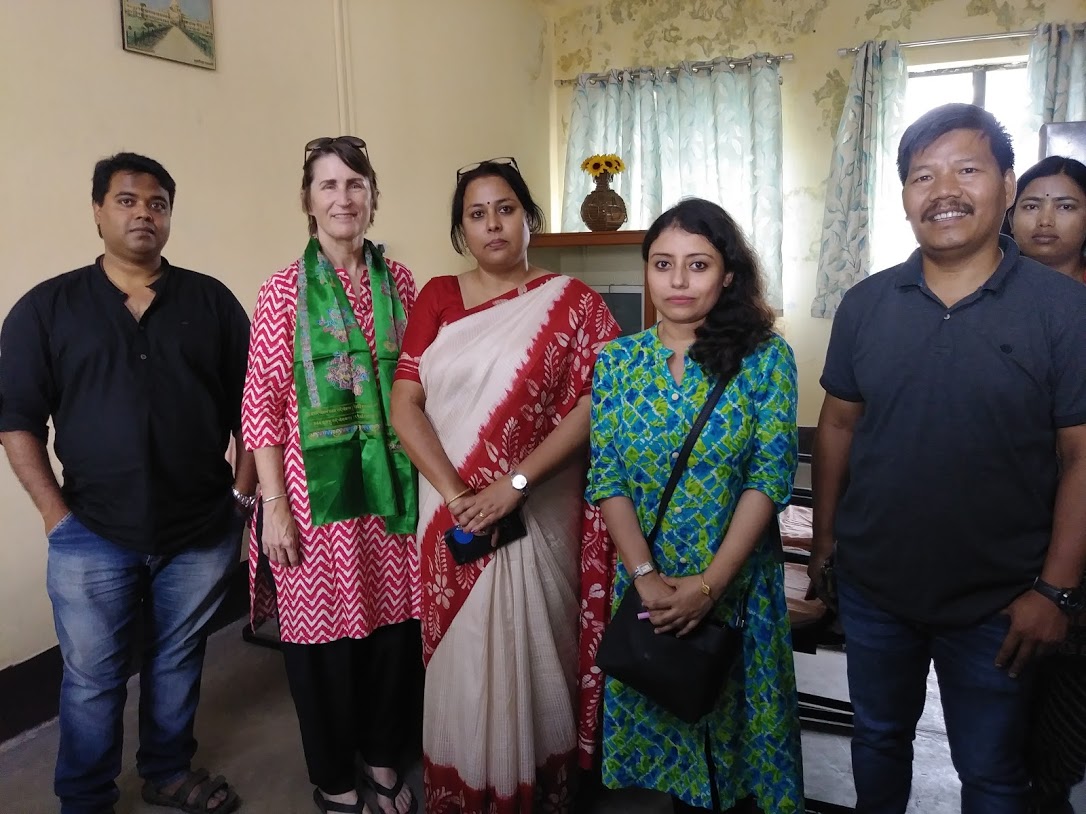
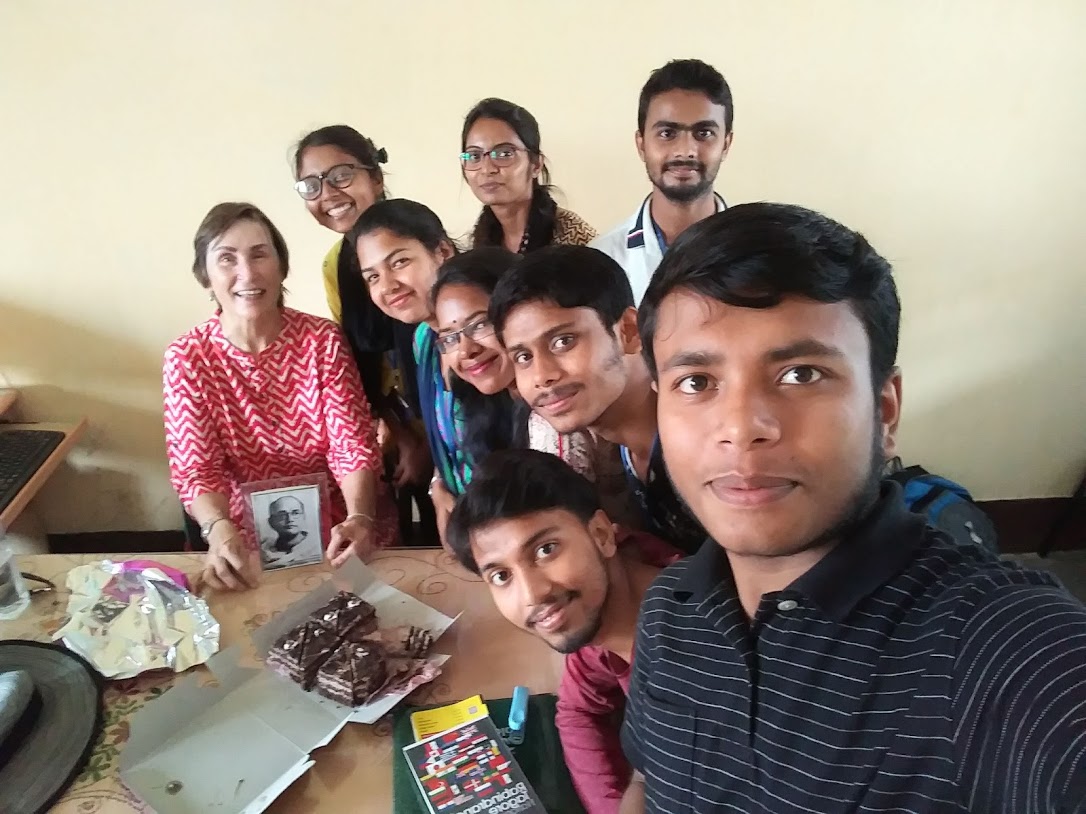
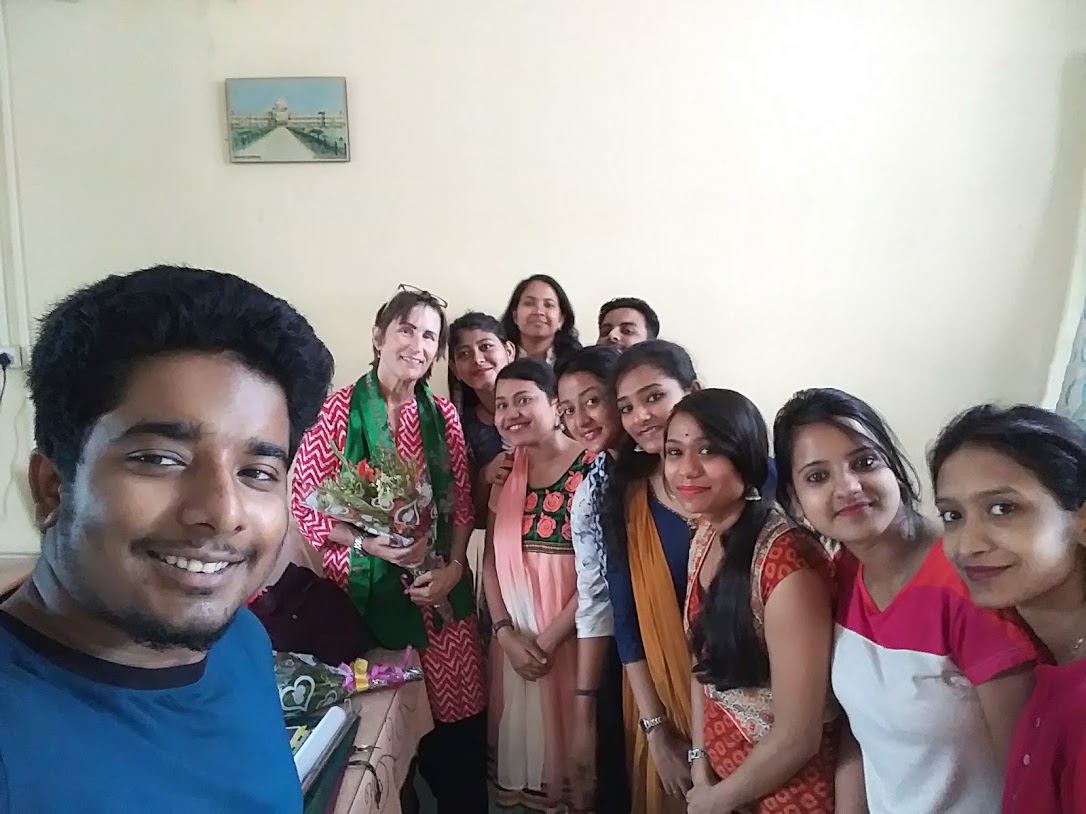
Saying farewell: History Department Faculty and Students. Tears were shed by me.
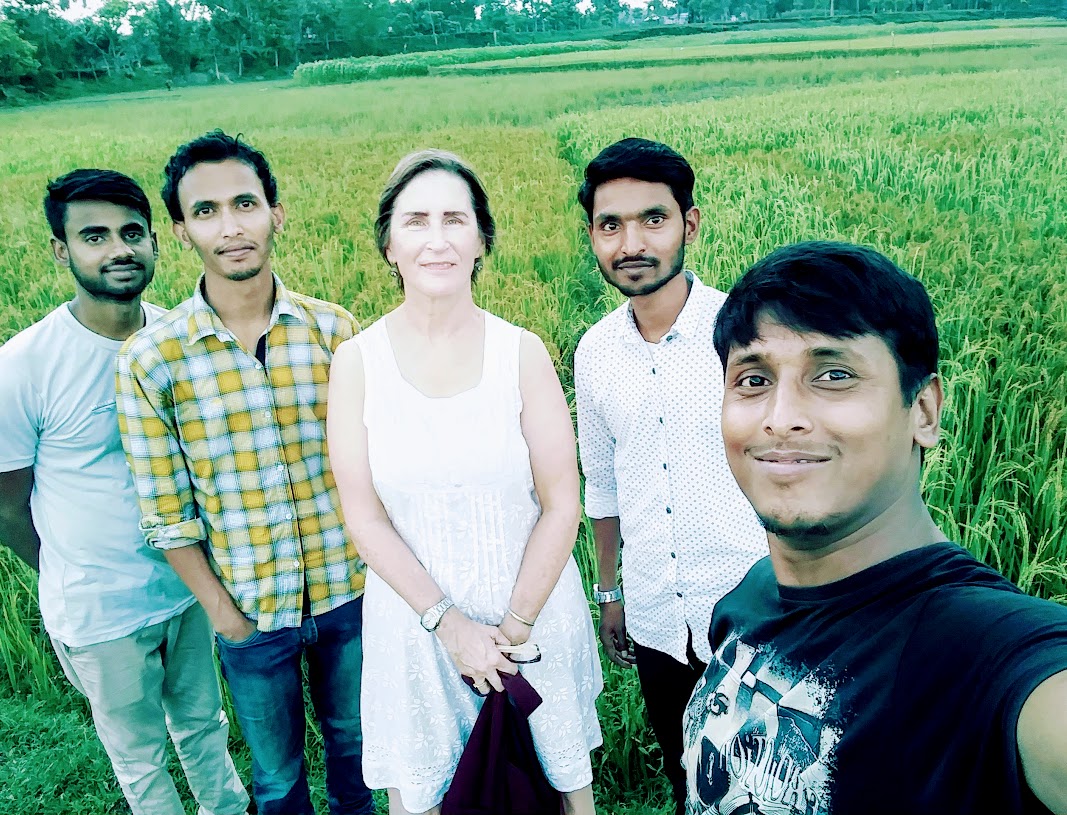
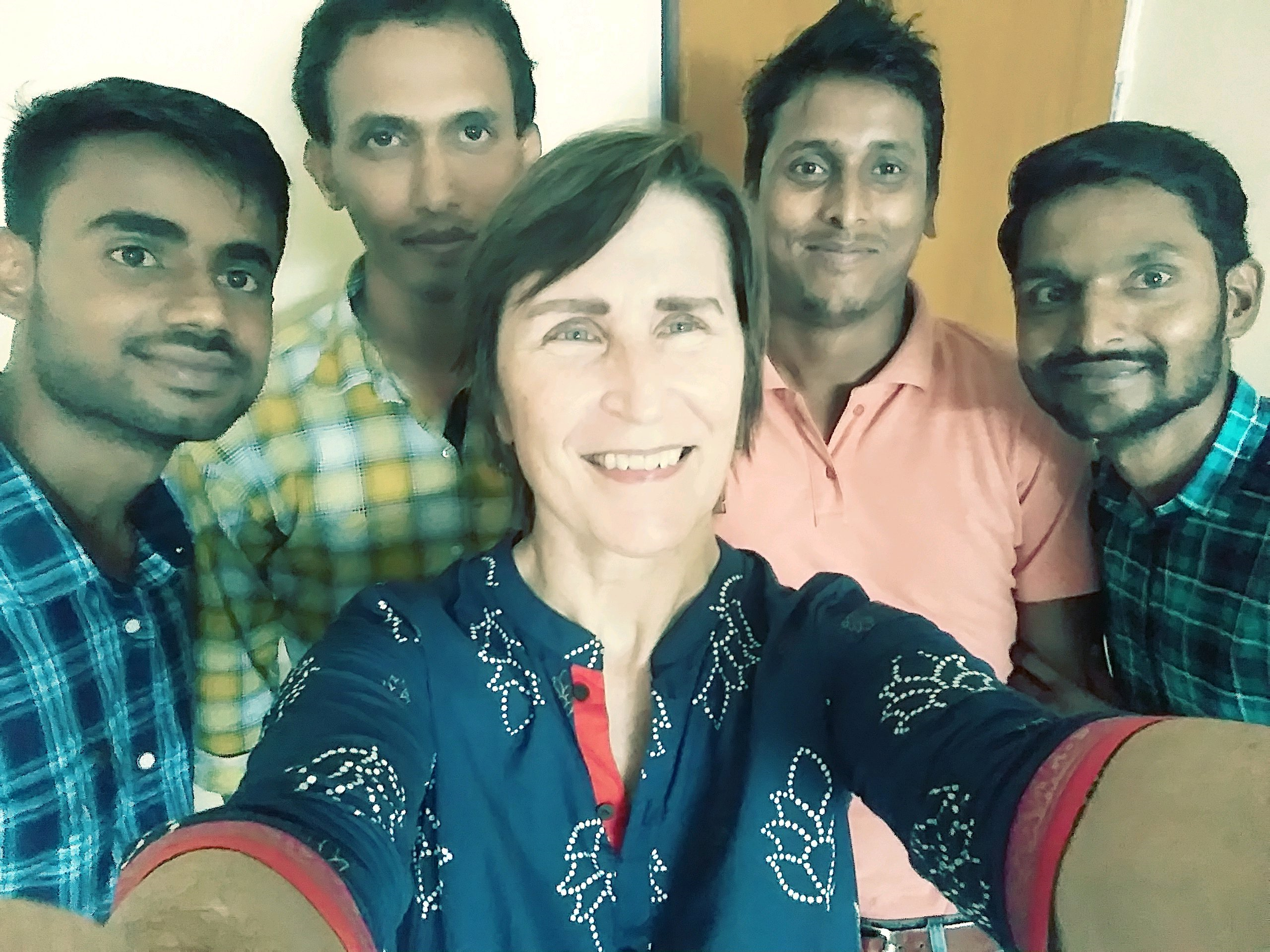
And…. These guys. I don’t know if I adopted them or they adopted me. Both, I guess. The best. Happy times and memories forever. Thanks.
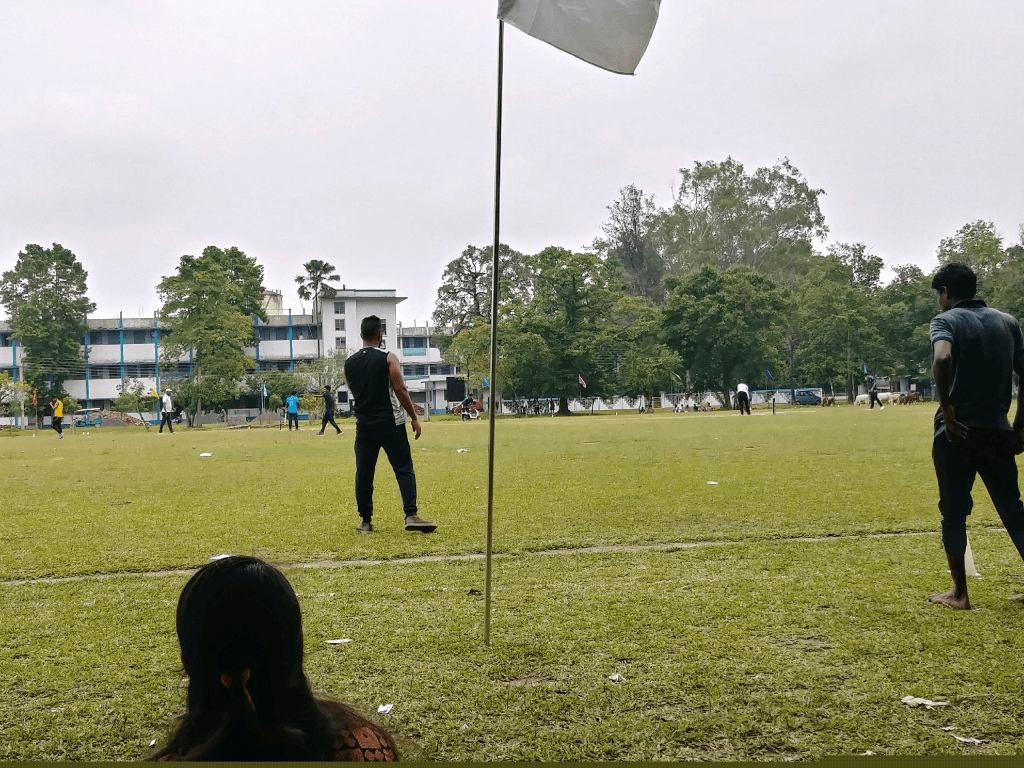
The cricket field was made in the large open field in the center of campus, which can also serve as a soccer field, or cow pasture.
The History Department men’s cricket team just won their cricket match against the Commerce Department men’s team in the NBU Intramural Cricket Tournament. That’s great news! Almost as exciting, I finally, finally have more or less figured out the basic rules of cricket. And I will share those basics (my version of them) with you! I also now understand why I have never been able to crack the cricket code before. The first problem is that people always say that cricket is “like baseball”. In fact it is not at all like baseball. Yes, you hit a round ball with a long object. But on that basis you could say that cricket is “like golf” because the similarities practically end there. Secondly, I’ve only seen cricket on television before. The way the camera zooms in on the action means you don’t get to see the overall field, and so it is difficult to track the general trajectory of the game.
So here is my very basic version of the rules of cricket; I don’t guarantee 100% accuracy! But I think it’s more or less correct. Just for fun, I decided not to read online about the rules. What follows is what I was able to glean from watching and asking questions.
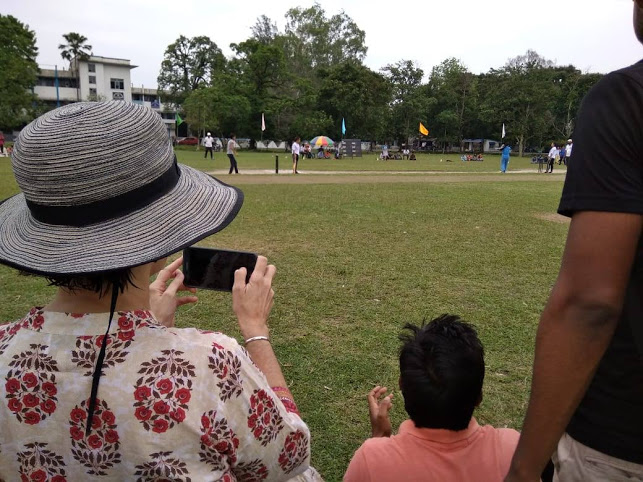
It’s kind of hard to make out anything in this picture, I now realize. But this is a cricket match in progress. You can barely make out one of the wickets, just to the side of the man in black pants and white shirt in the center right part of the picture. The other wicket is by the man in bright blue, center left of photo. That’s the Humanities Building in the background, by the way, where the History Department is located.
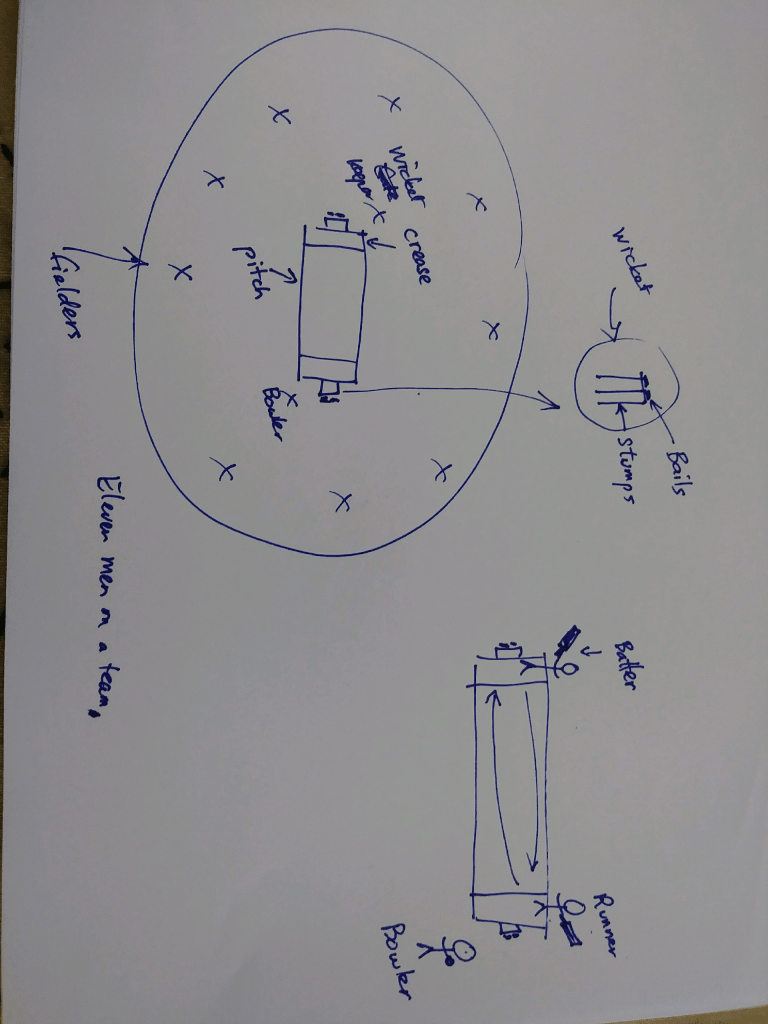
Cricket is played on a circular (maybe oval??) field. In the middle is the “pitch,” the long rectangular area where the bowling, batting and running take place. Fielders are posted around the field: in front of, behind and to the sides of the batter (from what I can tell, there is no such thing as a foul ball). At each end of the pitch is the “safe area” called the “crease” at the back of which is the wicket. The wicket consists of three stumps – tall stakes — pounded into the ground in a straight line atop of which sit two small pieces (of wood, I assume) called bails. The batter is protecting the bails from being dislodged from the stumps by the bowler. So when the bowler bowls, the batter defends the wicket by trying to bat the ball away. If the bowler succeeds in dislodging the bails, that is called a wicket. (Are you with me still?) A “wicket” refers to both the physical structure atop which the bails sit and also means “out”. When a player gets out – he (or she) is out of the batting line-up for the rest of the match. Two umpires are on the field at all times.
The match consists of two innings, and which team will go first is decided by a coin toss. (Hey! Cricket is just likebaseball!) Each inning consists of a set number of “overs,” which in the case of the NBU men’s intramural matches is 14 overs, but can be 20 overs, or 50 overs (or I think any agreed upon number). In the most traditional type of cricket, matches are played over a period of five days (those colonials had a lot of time on their hands, apparently!).
This shows the lay-out of the field, with the pitch in detail at the bottom right hand side. The bowler should be on the same side of the pitch as the batter (they are not bowling diagonally across the pitch). (Sorry for some reason I couldn’t rotate this photo.)
An over consists of six pitches – sorry, bowls – by the bowler. The batter bats at — tries for — all six bowls – if he strikes at the ball but misses, there is no penalty, he just tries for the next one. One of the umpires must determine whether the pitch is good or not, but I haven’t discerned the finer points there. If the batter makes a hit, he runs across the pitch to the wicket/crease on the other end of the pitch, and he must at least touch the tip of his bat behind the line of the crease in order to be safe – if the ball gets there before he does, he is out (again, called a wicket). As the batter runs to the other end of the pitch, another player, a teammate, who has been inside the crease at the opposite end also has to run, so as they run, they pass each other on the pitch. If it’s not obvious from where the ball has ended up after being batted, there has to be some communication (like a hand signal) between the runners as to whether or not they will run. If both runners successfully make it to the opposite crease, then that is counted as one run; depending on where the ball is, they can run back and forth multiple times. But if it looks like the ball can easily be delivered to the crease and get them out (it is only necessary to get one of them out), they will stop with one run. Not infrequently a batted ball doesn’t go very far, and the runners just stay put. (Unlike in baseball, the runner does not have to run after batting. Hmmm, baseball comparisons keep sneaking in here…) If the batter bats a ground ball that goes beyond the boundary without being touched by one of the opposing team’s fielders, that is four runs (the players don’t actually have to run them). If a fly ball is hit out of the field (what we would call a home run in baseball) then that is worth six runs. So those are the big payloads. Spectators shout, “Boundary! Boundary!” to cheer on the batter.
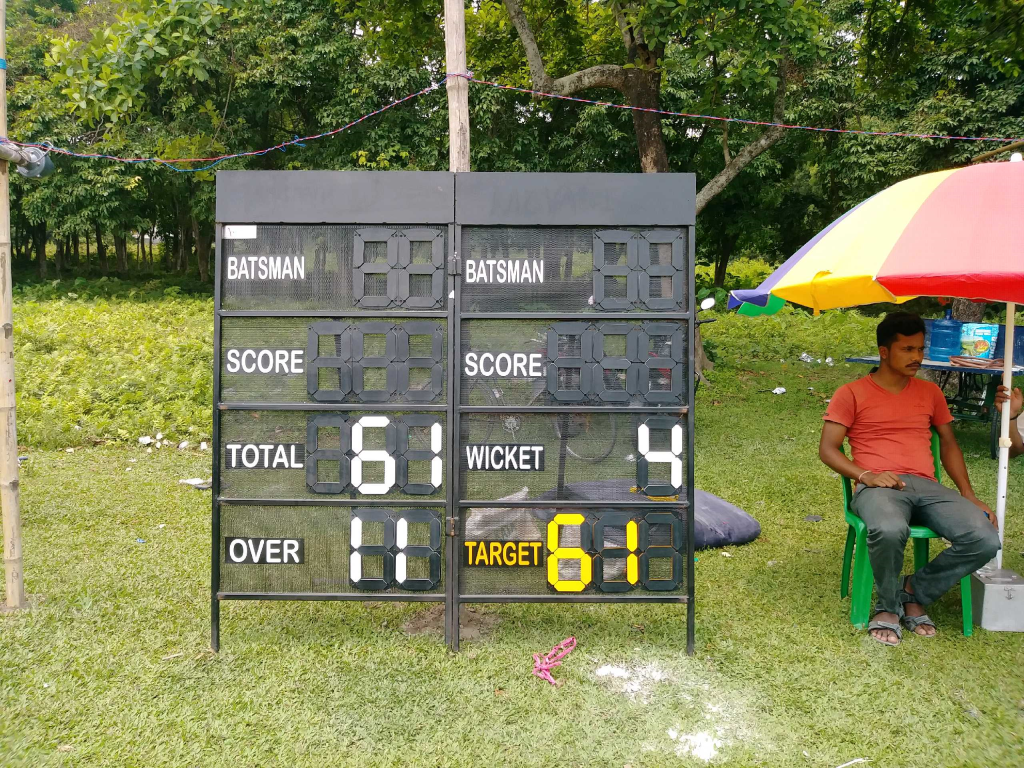
Scoreboard. “Wicket” means “out”. The target is the score which the team that goes second (batting in the second inning – the innings don’t have tops and bottoms) has to beat, or “chase”. If and when they beat it by one run, game over. It seems that savvy spectators keep an on-going tally in their heads of how many runs on how many remaining bowls have to be made in order to win.
After one over (of six balls) the bowler switches to the opposite end of the pitch (whichever of the two batters/runners is in hitting position hits) but the batters can continue to bat as long as they don’t get out, or as long as the captain or coach wants to keep them batting (I think). (Kind of weird it’s called a pitch, when the actual “pitching” is called “bowling”.) The object of the game, of course, is to make as many runs as possible within the allotted number of overs. Once your inning is over, that’s it for your team. The other team is “up” and they have the same set number of overs to try to outscore their opponent. So it seems to me there must be a slight advantage to being up second, because then you know exactly how many runs (points) you are “chasing”. If and when the second team has bested the first team by one run, the match is done and the rest of the overs are not played. (Just like in baseball (there I go again!!) when the bottom of the ninth is not played if the team that would be up already has enough runs to win.)
Anyway, you can disregard all of that if you want to — it’s kind of like reading the rules to Monopoly but not figuring out how to play until you actually do it. The main point was in the lead – the History Department men won their match and now it is onward and upward! Go History! Beat English!
Fantastic way to spend an afternoon! Newly minted cricket fan.
Lemon and Mint! Don’t mistake this for powdered juice mix!
This is the new little packet of laundry detergent I got the other day. Most laundry detergent comes in packages like this or slightly bigger. You can also purchase bars of laundry soap.
One hand full = ??
As the instructions on the packet suggest, most people do their laundry by hand. Or more accurately, most people (which is to say, most middle class people) have their maidservants do their laundry by hand. I’ve mentioned Poonam before, the young woman who has occasionally come by to clean my floor or wash my bedsheets. But I’ve discovered that basically, I’d rather just do my housework myself. (Not to cast aspersions — Poonam is very efficient.)
Does Anybody Really Know What Time It Is?
Does anybody really know what time it is? Does anybody really care? Unfortunately, yes. I care. And this is one of the main reasons I’d rather do my housework myself. Give me some time to explain how this all fits together. The picture above shows the wall clock on a friend’s wall, with my wristwatch in the foreground. Notice anything in particular about these two timepieces? I’m sure you do. Setting clocks ahead is a very common, perhaps universal practice here, a misguided or maybe I should say entirely disregarded effort to promote being “on time”. I haven’t written about the concept of “time” in India, which is very fluid. I haven’t written about it because it really is one of the most difficult aspects of functioning here. (It is difficult for me — I am an uptight person trying to pretend to be chill. I don’t think it is difficult for Indians.) I have tried very hard to stop caring about things and people being “on time”, and have tried very hard not to interpret people being “late” in any number of negative ways. How successful have I been? That’s for me to know and you to wonder.
One example will suffice, and then I’m not going to talk about it anymore. My class is scheduled to start at 10:30 a.m. By 10:40, some students start to show up in the outside corridor. By 10:45, the office peon arrives to unlock the classroom. By 10:50, I have hurriedly written my outline on the board and I turn around to say through clenched teeth, “Good morning class!” By about 11:15, most of the students have arrived. This system functions — I am the fly in this ointment — but I am basically not capable of making the adjustment of arriving for a 10:30 class at 10:45. I figure that in lots of ways I have to adjust my behavior to being here, but my class is my class and so I get to do my thing my way. So I told my students that I was going to run my classroom as I would run it in the US, and that in the US being “on time” is a mark of respect for your teacher, and I don’t care if they call me “ma’am”, and I don’t care if they stand up when I enter and leave the room, but I do care about them being on time — my time. (They’ve been pretty good, I will say that — they’ve made adjustments for this uptight American lady and made it easier for me to pretend to be chill.)
But this is the reason I’d rather do my housework myself — I don’t want to wait around for someone to come to my flat at “9:00 a.m. plus/minus” which is usually “minus” to the tune of 20-30 minutes. Okay — if I know that it is going to be 20-30 minutes, why don’t I just adjust to that? How would you answer that question? Arghh.
One of my favorite things to do when traveling is to visit local grocery stores and food shops. It’s the best sight-seeing around as far as I’m concerned. I love to see what people eat, because what people eat seems rich with personal, social, economic, political and historical information about a place. So here are some pics of some of the food items I currently have in my kitchen.
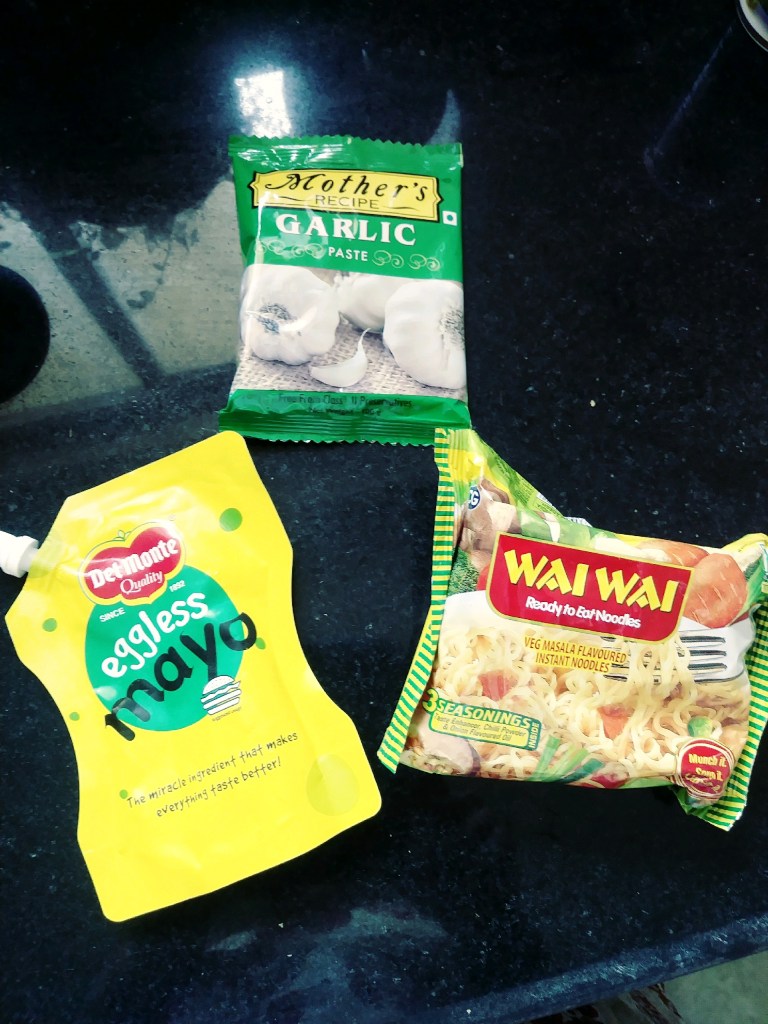
“The miracle ingredient that makes everything taste better!”
In the picture above are three miracle ingredients, IMHO. Well, I’m not sure I would call mayo a “miracle” but it is one of those things without which one cannot do, to put it succinctly. What IS miraculous about this particular mayo is the packaging — a little squeeze pouch — no more knives scraping fruitlessly against impossible-to-reach spots in cumbersome glass jars! Best Foods, time to up your game! Next is the pouch of garlic paste — I think that speaks for itself. And finally, Wai Wai noodles. These are just great. They are okay cooked, but uncooked they are a crunchy dream! One of my favorite quick meals is Wai Wai chaat — chaat is a generic term for a wide variety of street food-type snacks usually involving some mixture of crunchy and savory items mixed with various masalas (spices) and other flavorings.
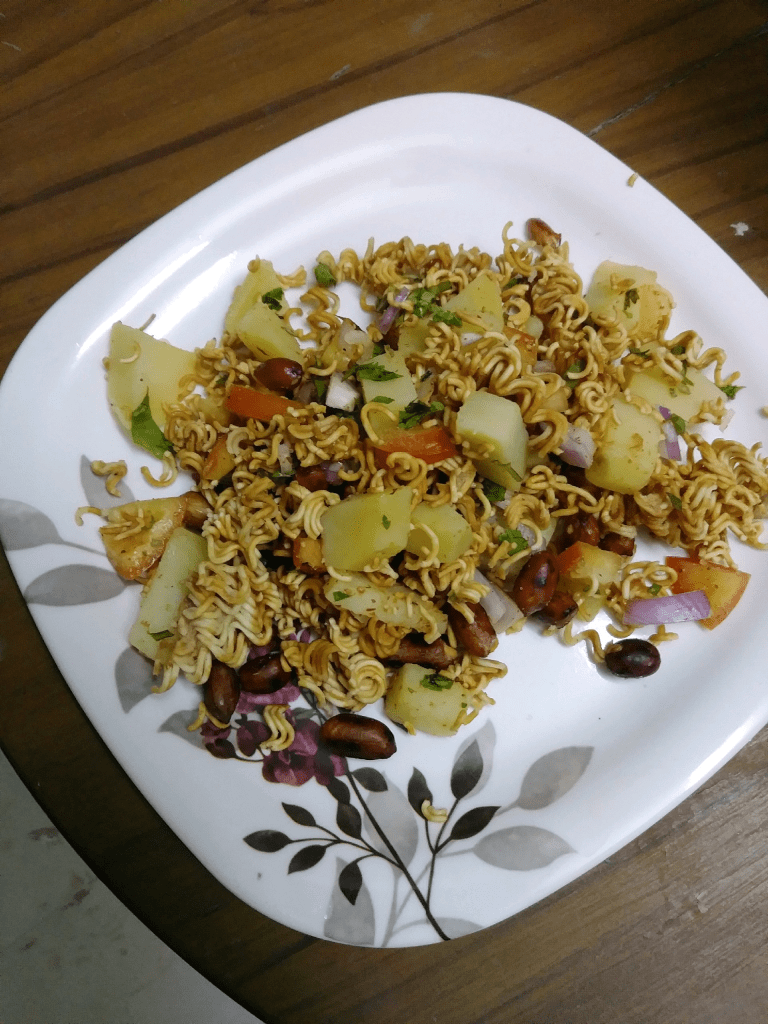
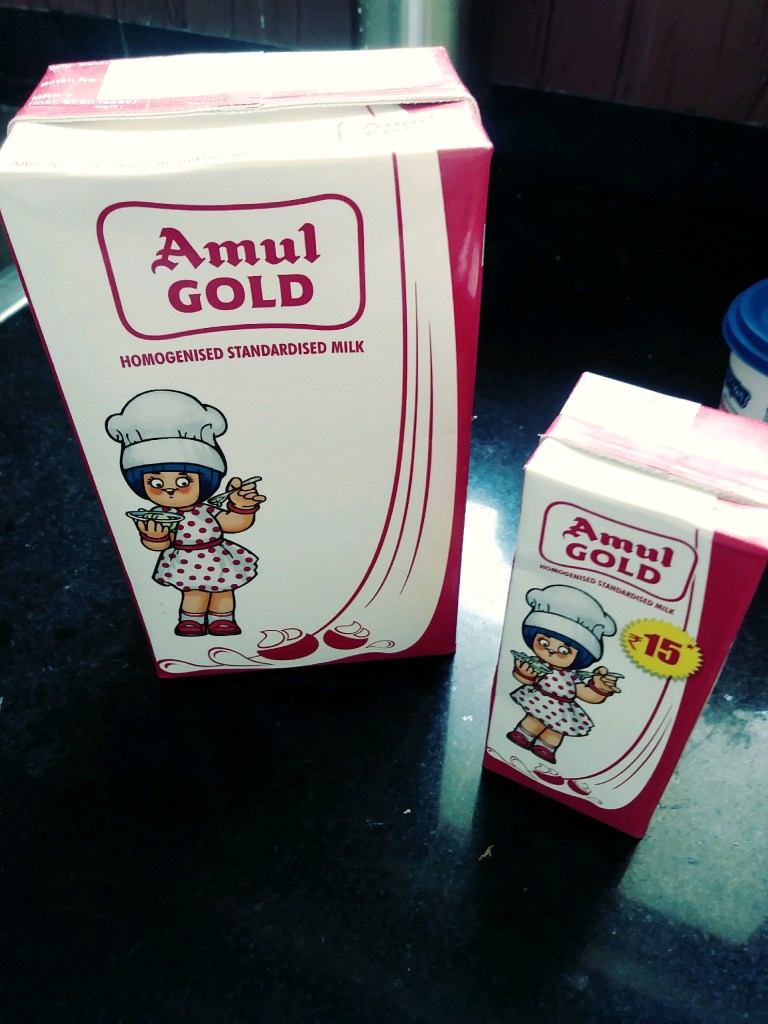
Wai Wai Chaat: In this concoction, cubed potatoes, tomatoes, peanuts, cilantro (here called coriander or dhania), onions, and… WAI WAI! If I have a cucumber or radishes or garbanzo beans I toss those in too. Then to top it off, the Wai Wai spice packets that come in the package, including a tiny packet of garlic-flavored oil — yum! Sooo satisfying!Typical vegies. Onions here are almost always these purple or “red” onions. Eggplants come in a wide variety of shapes, colors and sizes (I had some beautiful alabaster white eggplant the other day). Tomatoes are almost always this type, what we would call “Romas,.” Potatoes also come in a wide variety and usually are very good. And in the middle, garlic. Amul milk with the Amul girl! It’s utterly, butterly good (shouldn’t that be udderly butterly…?).
You saw the cows, now you see the milk! I always buy packaged milk, this is shelf-stable milk and comes in red cartons which is whole milk and blue cartons indicating “toned” milk, which I think is 2% milk. Interesting that the color-coding is the same as in the US. The larger carton is one liter and costs 64 rupees, about 90 cents; the smaller carton is 200 milliliters and costs 15 rupees, about 20 cents. I don’t actually drink milk (sorry mom!) but I get this for my coffee and for making “tak doi” — yogurt (or “curd”), which is very easy to make in this warm climate! Amul is the leading dairy brand here. A national company, it produces milk, cream, cheese (processed cheese – yuck), yogurt and butter. I think the Amul girl has come to symbolize that something is trustworthy, wholesome and good. The ad campaigns featuring her are often very cute — as you can perhaps surmise from the slogan, “Utterly Butterly Good”!
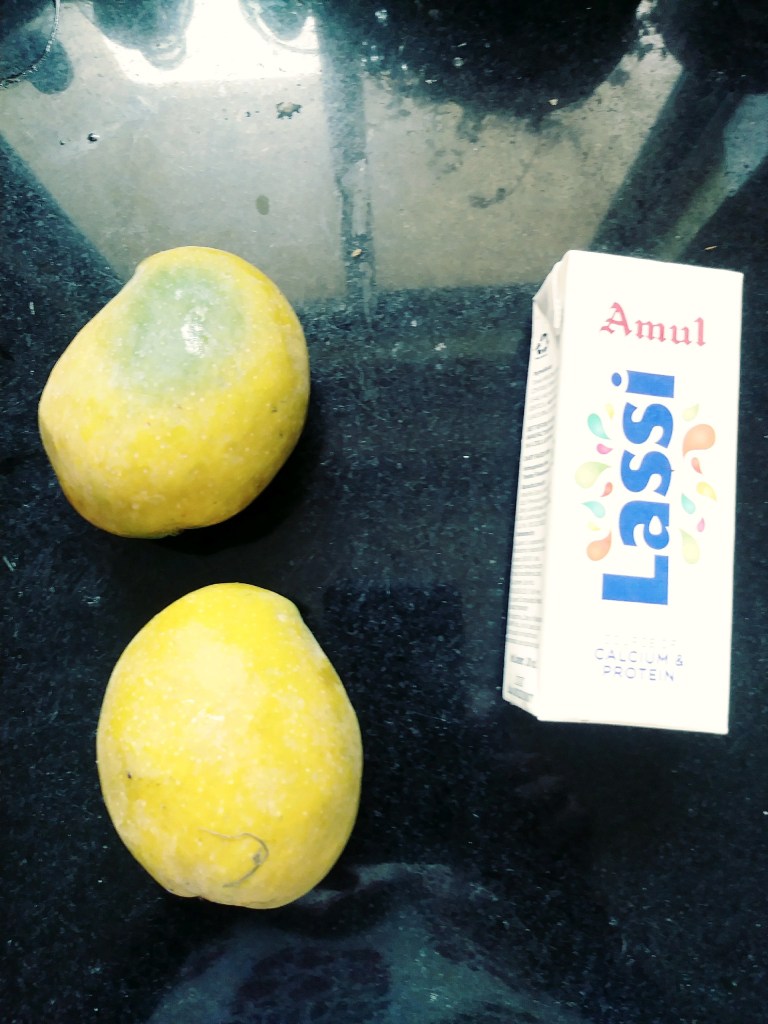
Another Amul product — lassi!
Lassi is a yogurt drink that can be sweet, fruit-flavored or slightly salty with a hint of cumin. Also in the picture are some early (and not very good but way better than any I’ve had in the US) mangos. These are not local mangos yet, I think they will come in another month or so — so sweet and delicious, a real treat!
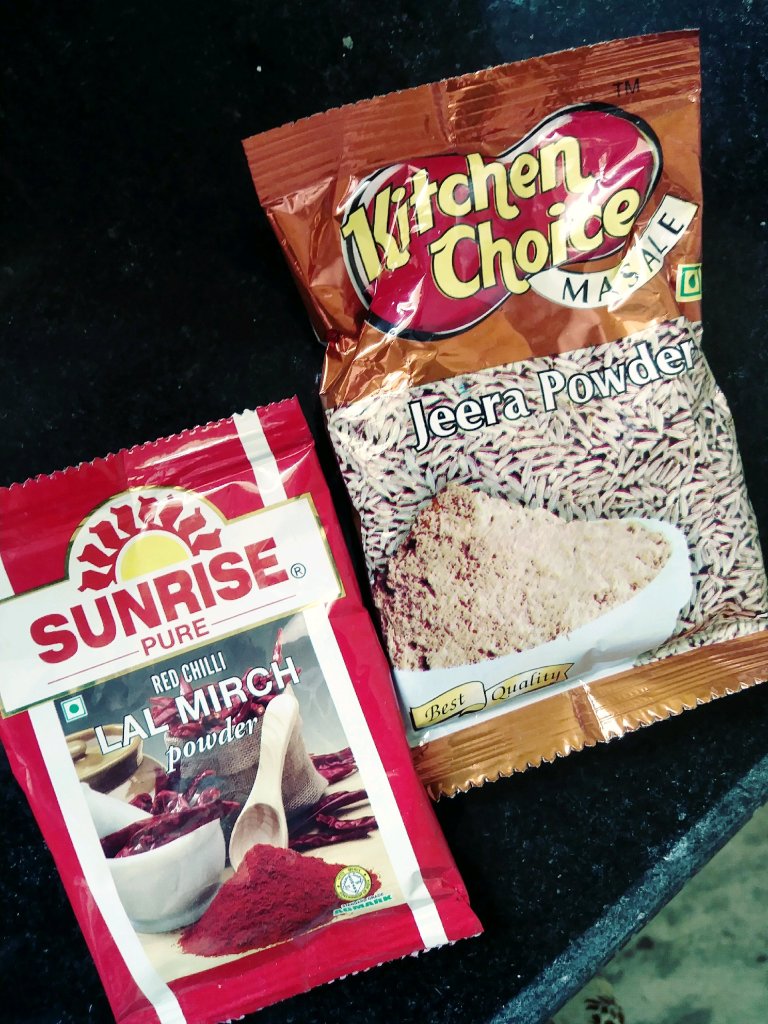
Spice packets
Spices — masalas — come in these kinds of packets. They are ubiquitous — every grocery store will have a relatively largish section selling masalas. And they are very cheap — this jeera powder (about six tablespoons of ground cumin) was 25 rupees, and the lal mirch (about one and a half tablespoons of red chili powder) was 4 rupees — that’s about 36 and 6 cents respectively.
Black salt is a kind of sulfur-y salt — might sound kind of yucky, but it’s really good, it adds a nice little punch. Don’t ask me why the label has a picture of fruit on it — I have no idea! Maybe people use it on some fruits, but if they do, it isn’t on grapes and apples and bananas! In regular cooking, people use white table salt, and in general, to my taste, people like their food quite salty. The peanut butter — wow, was this stuff horrible! I got this tiny tub to make peanut butter cookies for some friends. The peanut butter tastes like it was processed in a machine that had recently been lubricated with diesel oil. Next stop, the rubbish bin!
A couple of breakfast items
“Iron shakti”! Shakti means power, or strength, so obviously, these corn flakes make you run faster and jump higher! You may have noticed on the packaging in some of the pictures a little green dot (you can see it at the top of the Kellogg’s box). All packaged foods in India are marked as vegetarian (green dot) or non-vegetarian (red dot). I’m not vegetarian, but it would be a lot easier to be vegetarian here than in the US. In a way, I’ve become de facto “veg” (as they say here) because I rarely have meat unless I eat out.
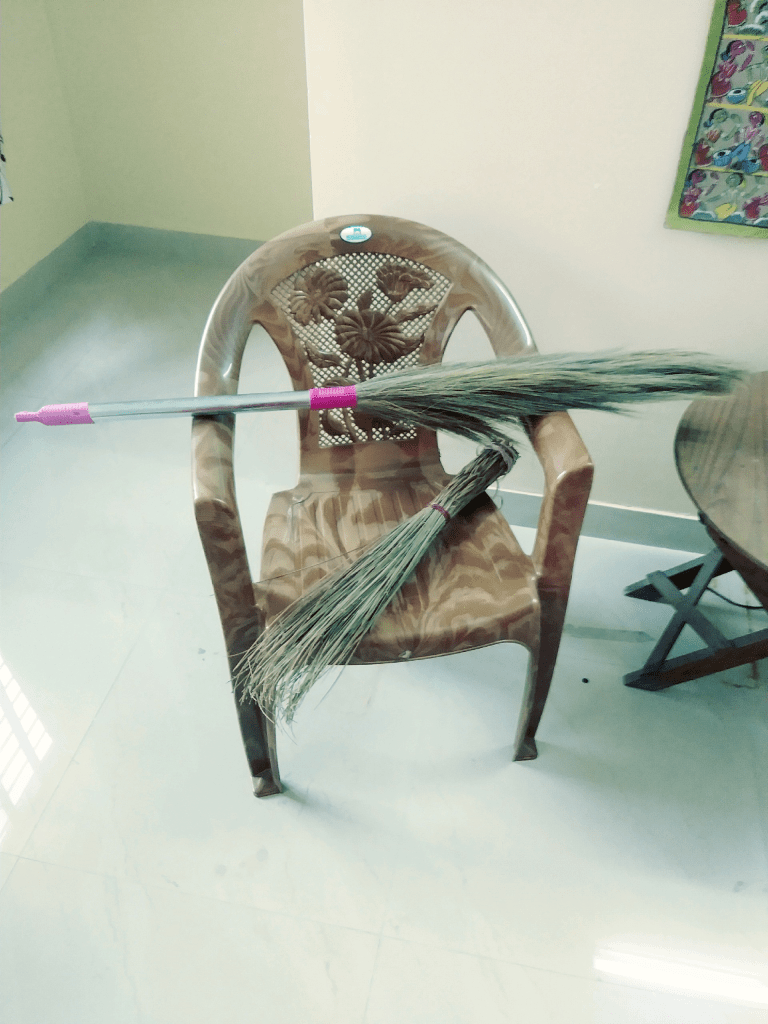
I just swept my floor with my wonder broom. I am so impressed with my wonder broom that I thought you might enjoy seeing it. My wonder broom is the long one, given pride of place in the top spot on my plastic armchair. (I don’t store the brooms in my plastic armchair, although I could, because it turns out I almost never sit in my plastic armchair. I just posed them here for the photograph so you could see their size.)
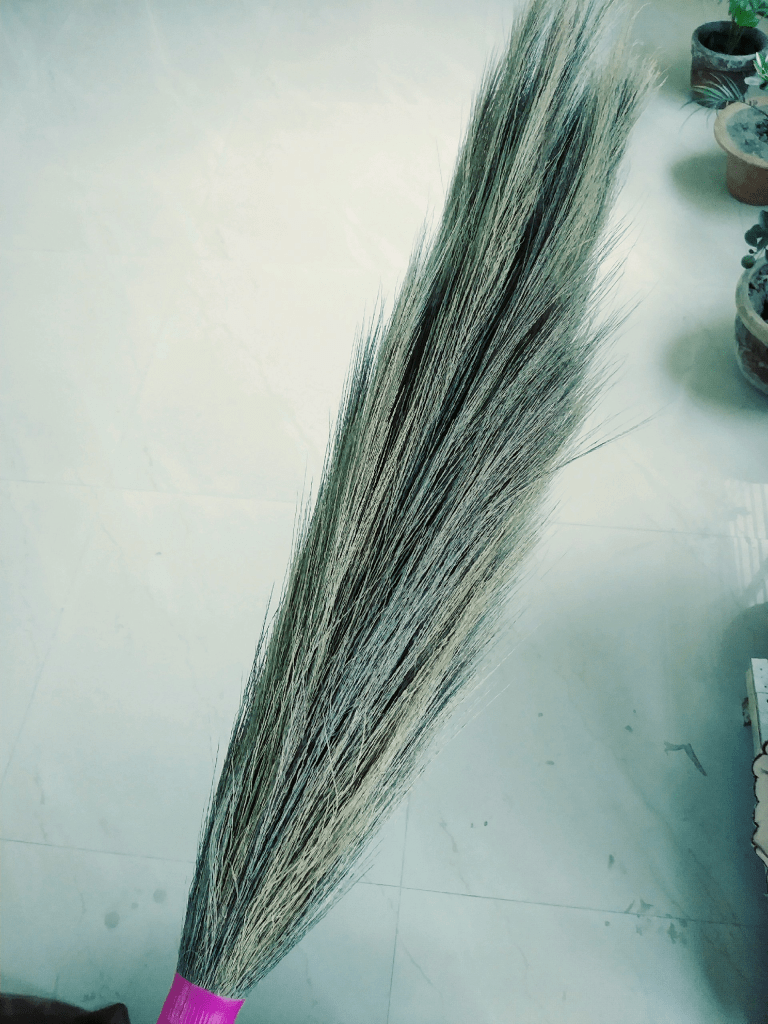
Made with natural fibers!
I don’t actually know what the sweeping part of this broom is made of (the rest is aluminum and plastic, as you can probably tell). But this natural fiber, some sort of grass, is quite amazing. It is both soft and strong, it has a wide sweep-span, and it catches even the tiniest specks of grit. In the US I would call these specks dust, but here they are definitely grit — tiny but mighty! For some reason, there are many, many newly-arrived, tiny and not-so-tiny specks of grit on my floor each day. That makes it fun to sweep, of course. It wouldn’t be fun to sweep if your floor was spic and span, would it? Even if I don’t keep my windows open, the grit accumulates. Sometimes for extra fun I let my floor go for a couple of days!
The other broom, the coarse one, is one that I inherited from a previous occupant of this flat. I have never used it. I guess it is for larger-scale items than grit. I’ve seen people using this type of broom outdoors to sweep up garbage and leaves and such. Anyway, I thought I’d include it just to give a broader spectrum of broom types available here. (Post-script to this paragraph: The other day I discovered that the “other broom” is for cleaning toilets! I saw one on a commercial for toilet bowl cleaner. LOL and Gross! I had it on my plastic armchair! Oh well, I hardly ever sit in my plastic armchair anyway.)
One observation I would make about these brooms is that as you can see, both have short handles, which means that in order to use them, you have to stoop down. To me (as someone who has never shied away from over-analyzing things) this is because sweeping is women’s work. It seems that when jobs are primarily for women, the tools tend to be inconvenient or not very nice. To extend the example from tools to workspaces, kitchens here tend to be quite cramped, dark and generally unpleasant compared to other rooms in the house. Not only is a woman’s work never done, it is often not easily done. On the other hand, in a dark kitchen it is harder to see that the floor needs sweeping!
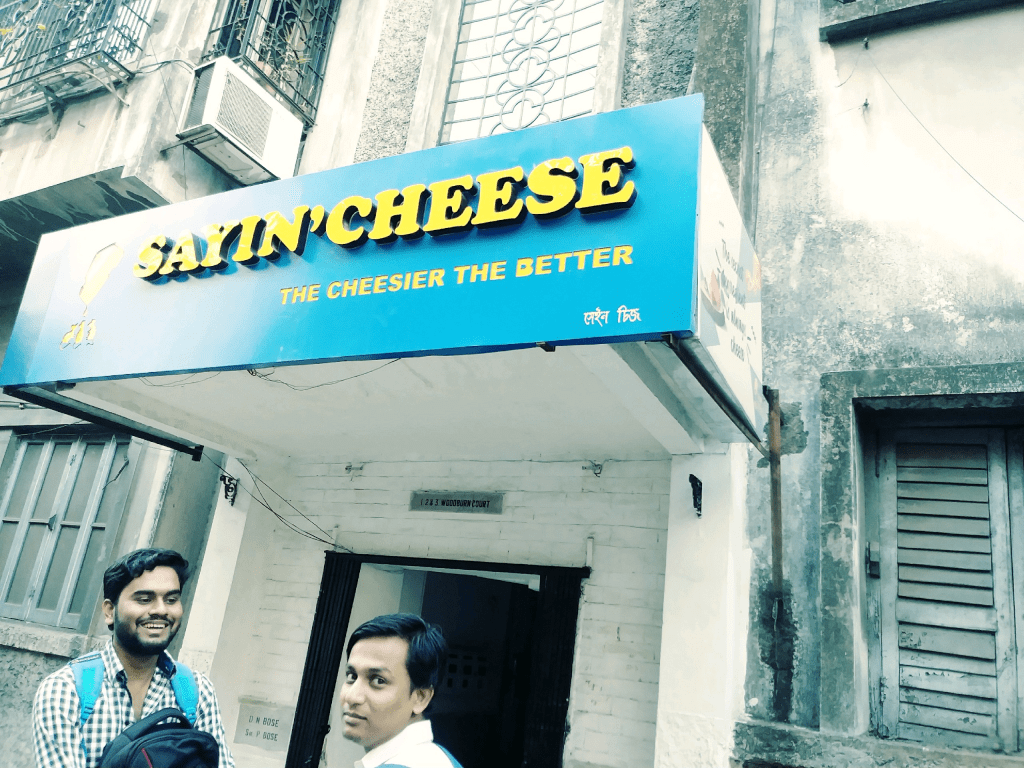
I agree with your assertions, “the cheesier the better” and “the secret ingredient is always cheese”. My concern is this: Why are you never open? Don’t you like me?
Sincerely yours,
Mary
P.S. These young men are also wondering why you are never open.
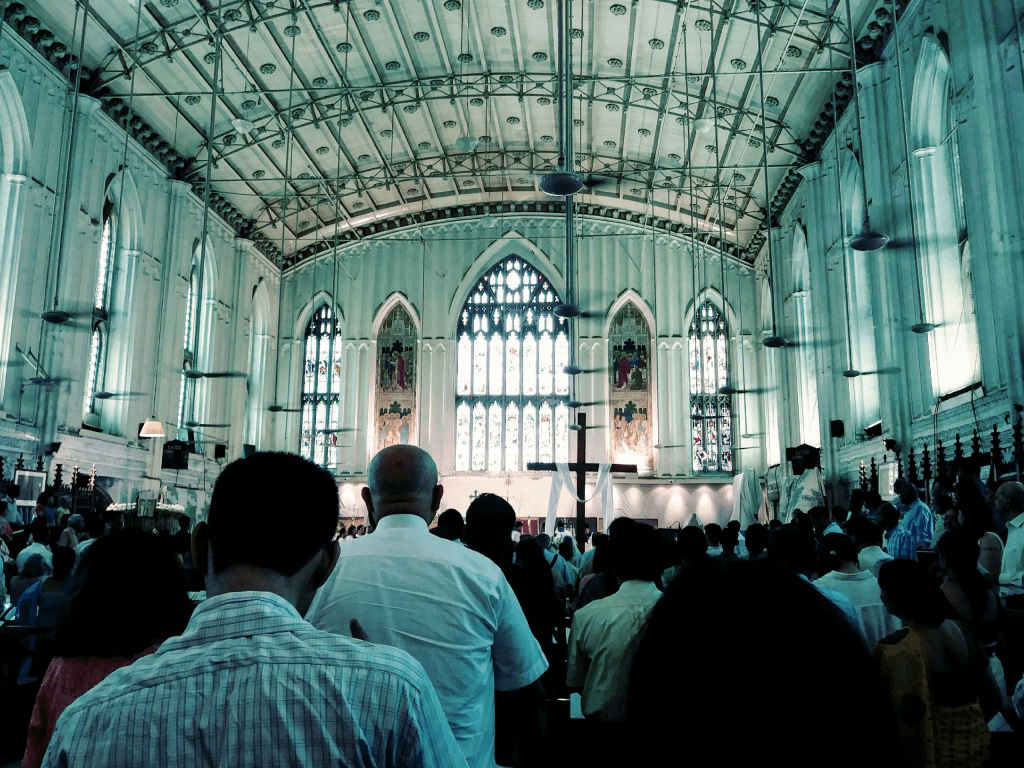
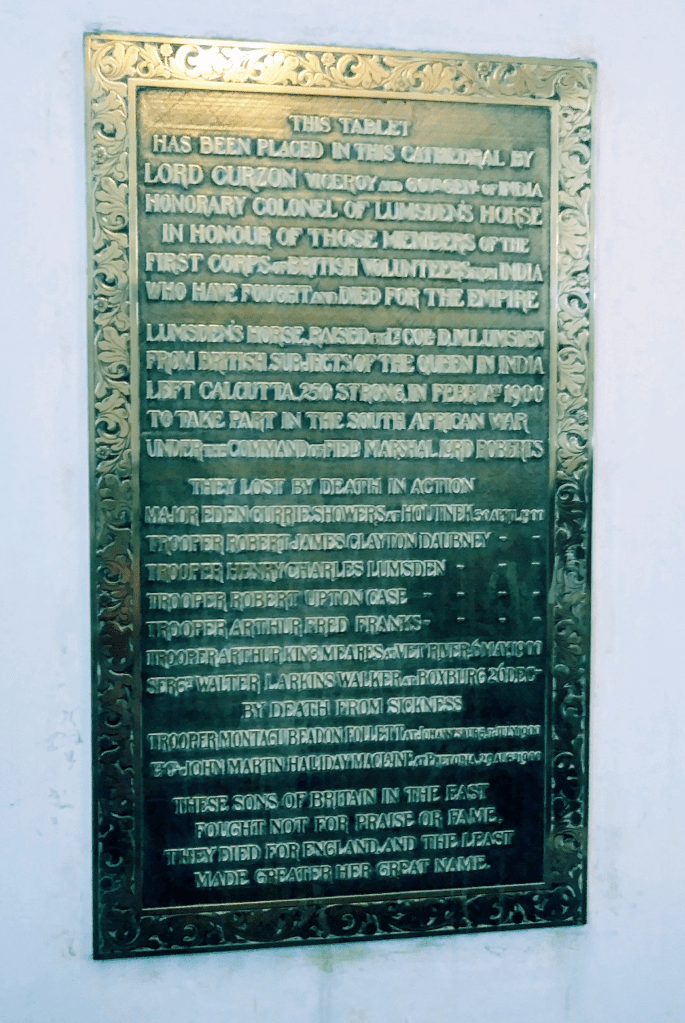
I came to Calcutta yesterday. I am here to do some research on Subhas Chandra Bose (if anything turns up, I’ll be sure to post — are you waiting with bated breath?? It’s pretty interesting, actually!). I timed my visit to coincide with Easter so that I could attend services at St. Paul’s, the Anglican cathedral built in 1847, the first Episcopal church in Asia.
Who needs chandeliers? Thank God for ceiling fans!
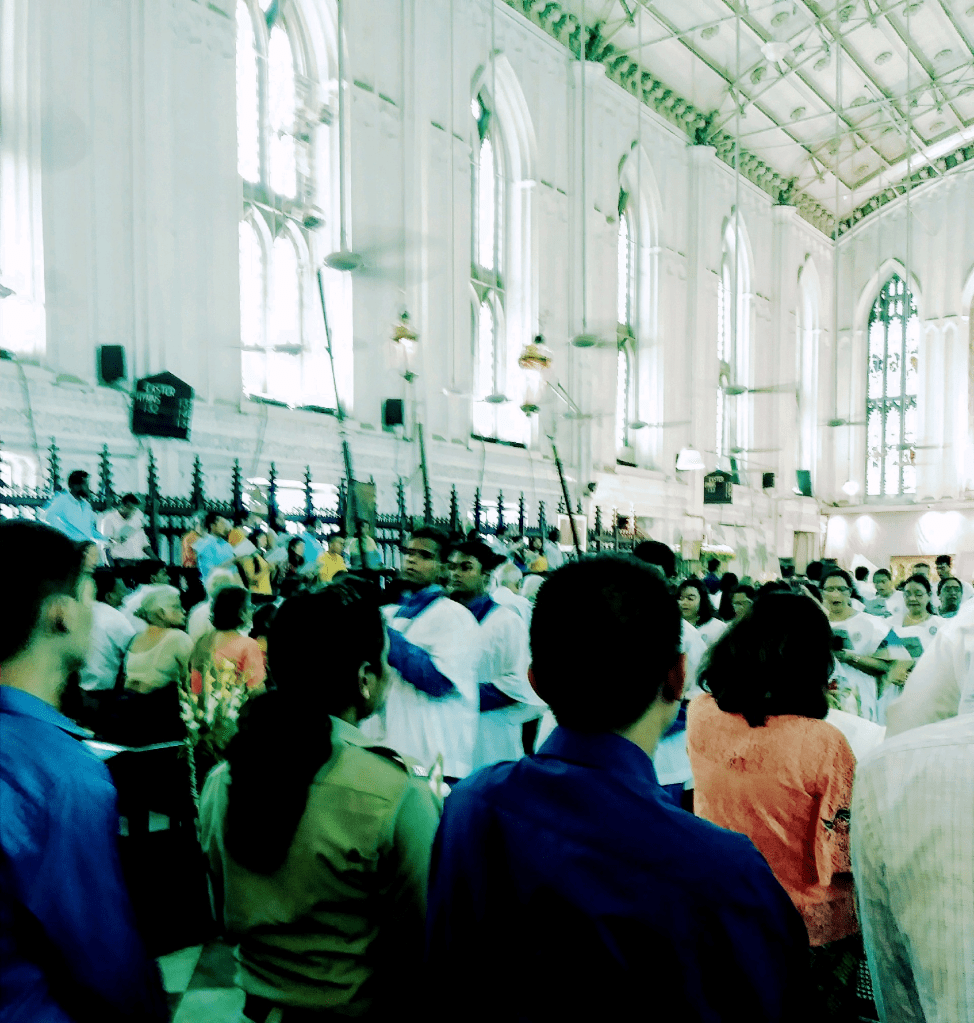
The church seats between 800 and 1000 people and it was completely full. Attending the Easter service was a bit like being in Canada — familiar… but different! The service began at 8:30 a.m. and was conducted in English (I was one of maybe 5-6 Anglos there). A Bengali service was scheduled for 10:30 — I should have gone to that too, it would have been interesting. (I gave a miss to the 6:30 a.m. “sunrise” service…) Although there was not much music, we did sing four hymns, including “The Strife is O’er,” and “Lift High the Cross.” Very moving to sing these familiar hymns in such a different setting.
In Hindu temples it is the custom to take off one’s shoes and I noticed that many people had taken off theirs. Another example of Indian culture in this distinctly Anglican setting was the Eucharist — as soon as the Eucharist began, people immediately popped out of their chairs and made their way to the center aisle. (This was old style seating, with a long desk that ran in front of each row, and individual kneelers, which were not used). Standing in line can be a rough and ready experience in India — you snooze, you lose — so I couldn’t help but wonder how this would translate out. With a few exceptions (!), it was quite orderly!
Given that alcohol is so difficult to find here (have I complained about that before? I think I have complained about that before) I was curious about whether they would use wine for the Eucharist. When the priest got to me, he (no female clergy at this service) asked me something. I said “yes” (when in doubt, say yes) because what I think he must have asked me is whether I wanted him to intinct the communion wafer. (My spell-check is rejecting “intinct”.) Anyway, this is when my question was answered — he dipped the wafer in the chalice and put it on my tongue and it was…. well, I think it must have been vinegar!
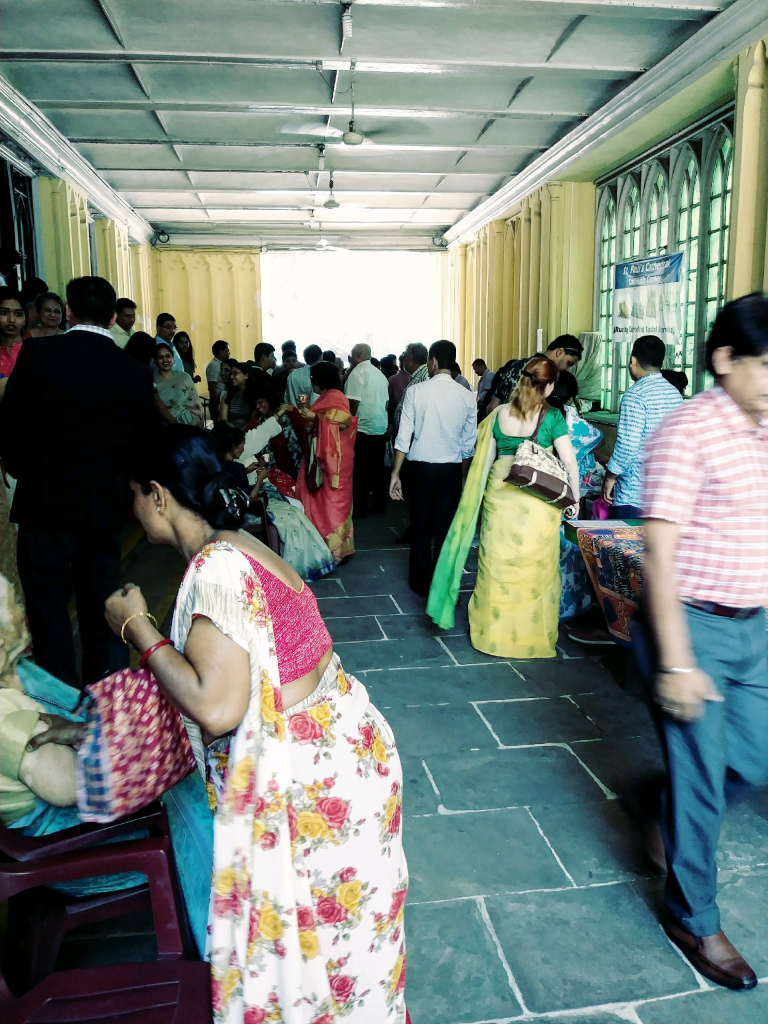
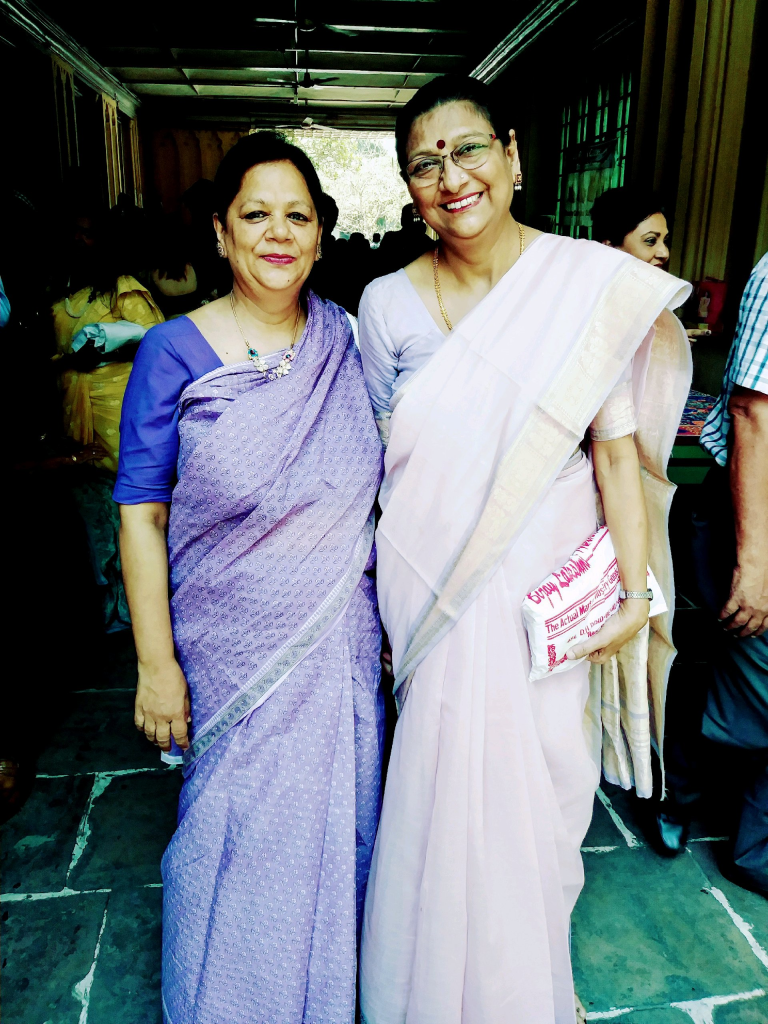
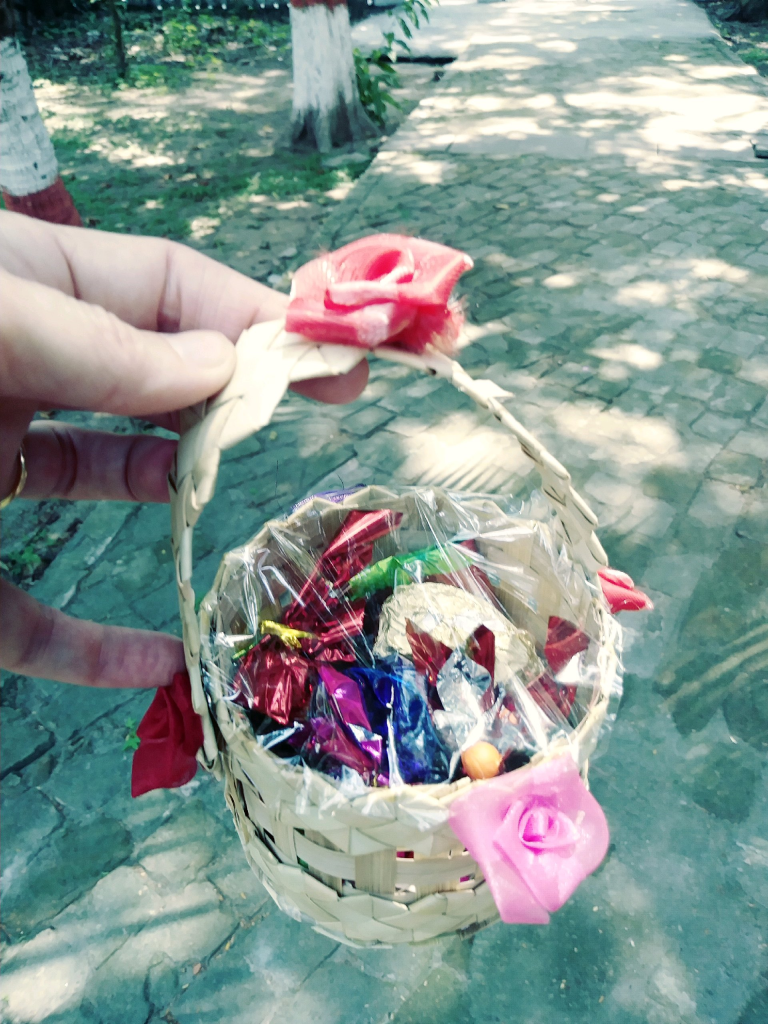
Recessional. No photography allowed in church, folks. But I wasn’t the only disobedient one among the flock. After the service a tea reception was held in this covered outdoor area, called “the porch”.I loved their beautiful Easter saris! The picture doesn’t do justice to the pale pink one, a shimmery shantung silk. At the reception a woman was selling these little Easter baskets — I donated some rupees and got this chocolate-filled delight (lined with Christmas wrapping paper, I discovered after I gobbled down a couple of chocolates). What I thought were jelly beans turned out to be pieces of colored plastic foam! And finally, let us pause to consider why there is an Anglican cathedral in Calcutta in the first place: the tainted cause of Empire.
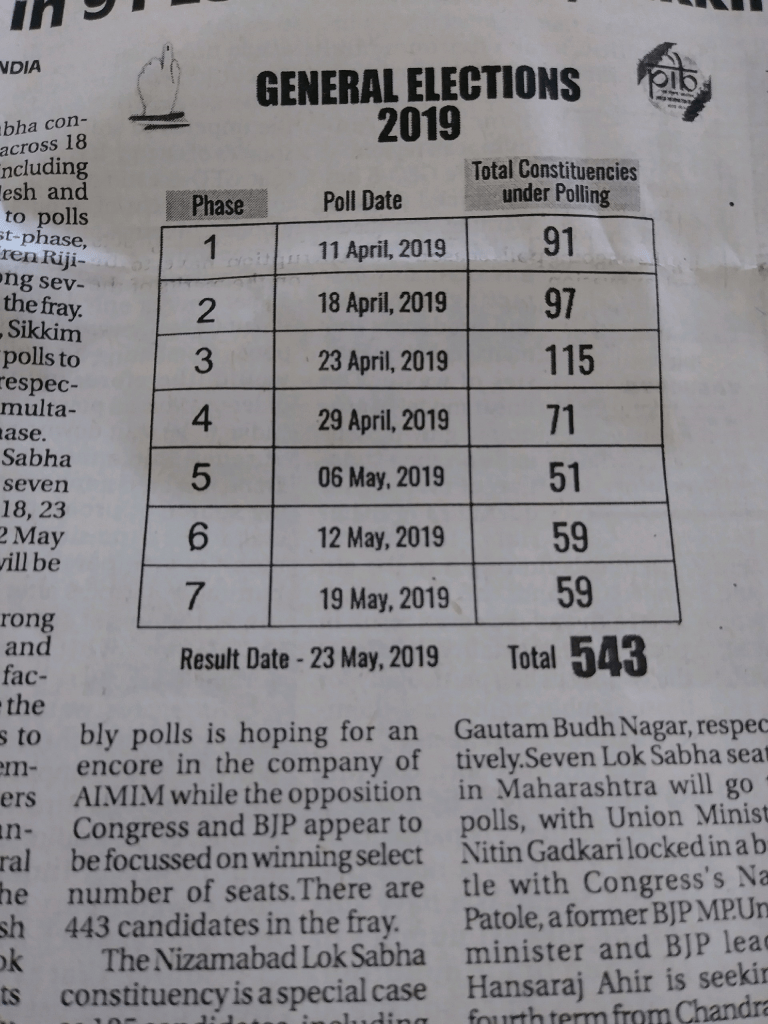
India’s big national election is underway. When you have nearly 900 million voters, an average turn-out rate of some 70%, and a history of elections being disrupted by violence and vote-rigging, you hold the elections in stages to try to ensure a peaceful, open process in which every voter who wants to vote gets to vote. That means massive oversight by the police and a huge number of “volunteer” civilian election monitors. Voting takes place over a period of five weeks.
This chart in the newspaper shows the election schedule; voting in my area happens on Thursday, April 18.
All 542 seats in the Lok Sabha, the lower house of the bicameral Parliament, are being contested, something that happens every five years. The 2019 election is being seen (this is my interpretation) as something of a referendum on Prime Minister Narendra Modi’s popularity and thus on the popularity of his Hindu nationalist BJP (Bharatiya Janata Party) — something like the US midterms having served as a Trump-test.
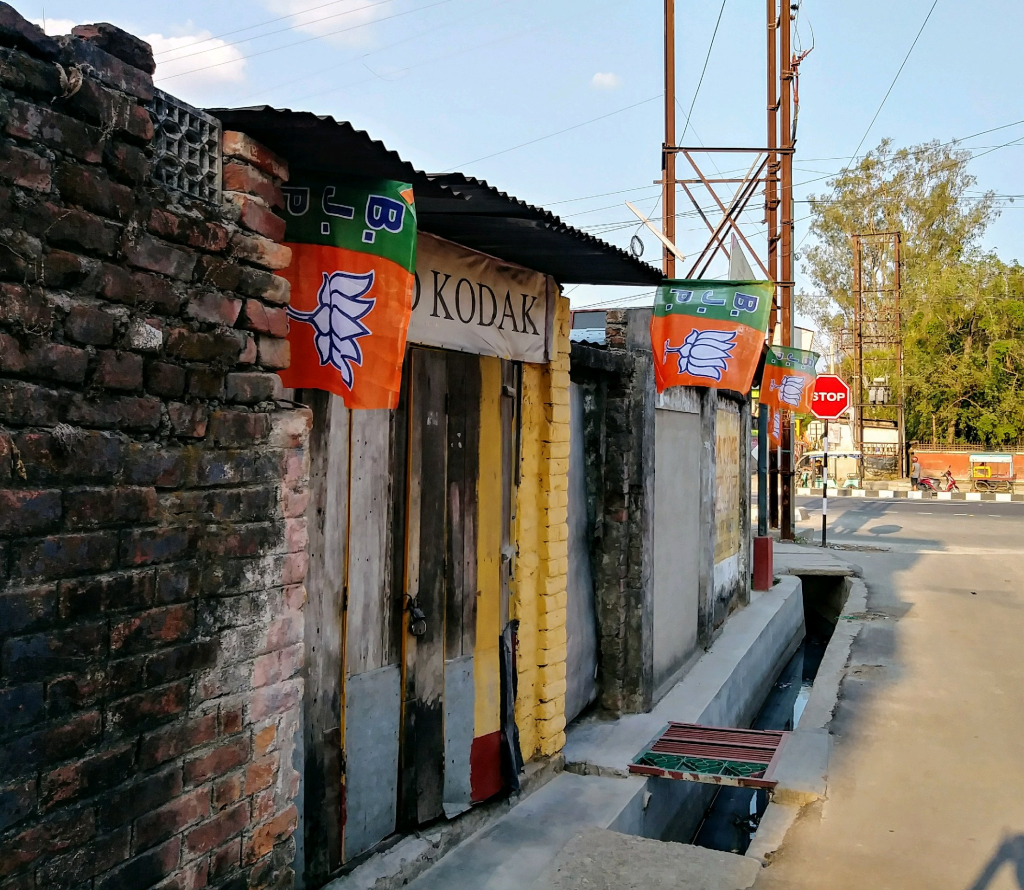
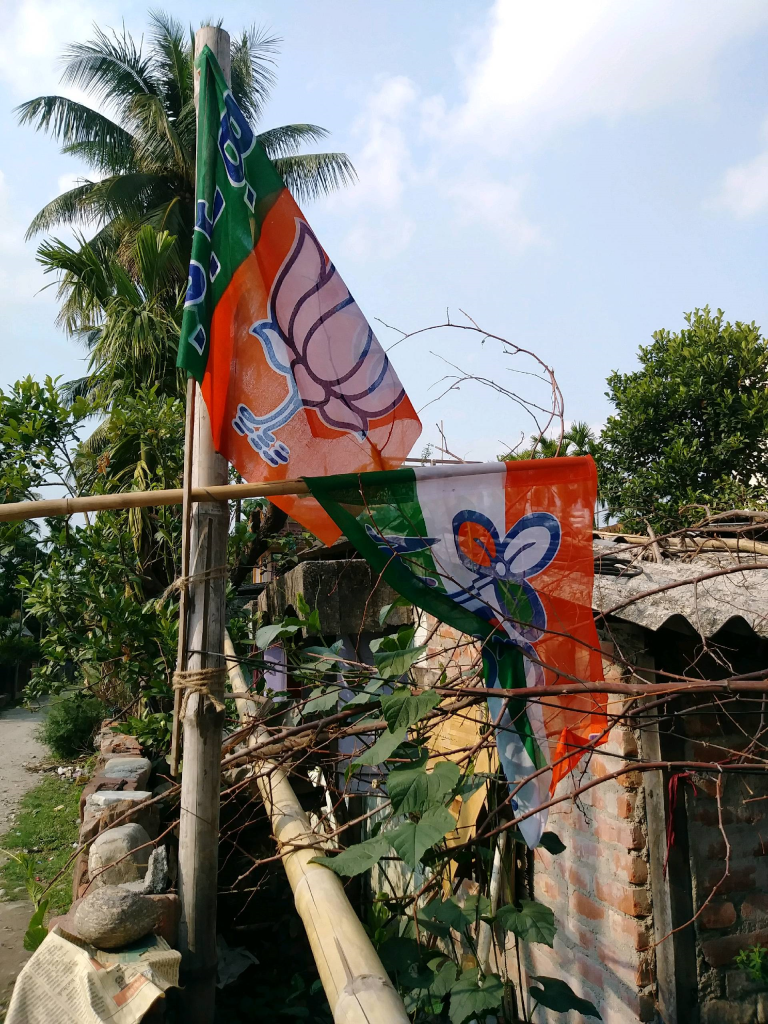
Election flags are all over the place, like these BJP flags right around the corner from my flat.
These BJP flags sport the lotus symbol. In Hindu and Buddhist symbology, the lotus flower represents enlightenment — its roots are in the mud, but it blooms in purity on the surface of the water. To me, it is odd (and disquieting) to see it used as a political symbol. But hey, that’s Hindu nationalism for ya!
This not-very-good picture shows the BJP flag along with a Trinamul Congress flag.
The main party in opposition to the BJP is the Indian National Congress, the party of Nehru. The most prominent Congress politician currently is Congress President Rahul Gandhi, who is Nehru’s great grandson, Indira Gandhi’s grandson, and the son of former Prime Minister Rajiv Gandhi (assassinated by the Tamil Tigers in 1989) and former Congress President Sonia Gandhi. (Got that? There will be a short quiz at the end.) His sister Priyanka, who seems to have a lot more pizazz than he does, supposedly sounds just like her grandmother Indira and has recently formally entered politics. (Which means, as far as I can tell, that the newspapers report on what outfit she wore to the latest rally.) I actually don’t have a picture of a Congress campaign flag because there aren’t a whole bunch of them around here. But guess what color they are? Orange, green and white! I asked someone “Why do all the parties use the same colors?” and then I thought, “Oh. Red, white and blue, never mind.” Congress is not that popular in West Bengal because they have been eclipsed by a Congress-offshoot called Trinamul Congress. At any rate, both Congress and Trinamul Congress are anti-BJP.
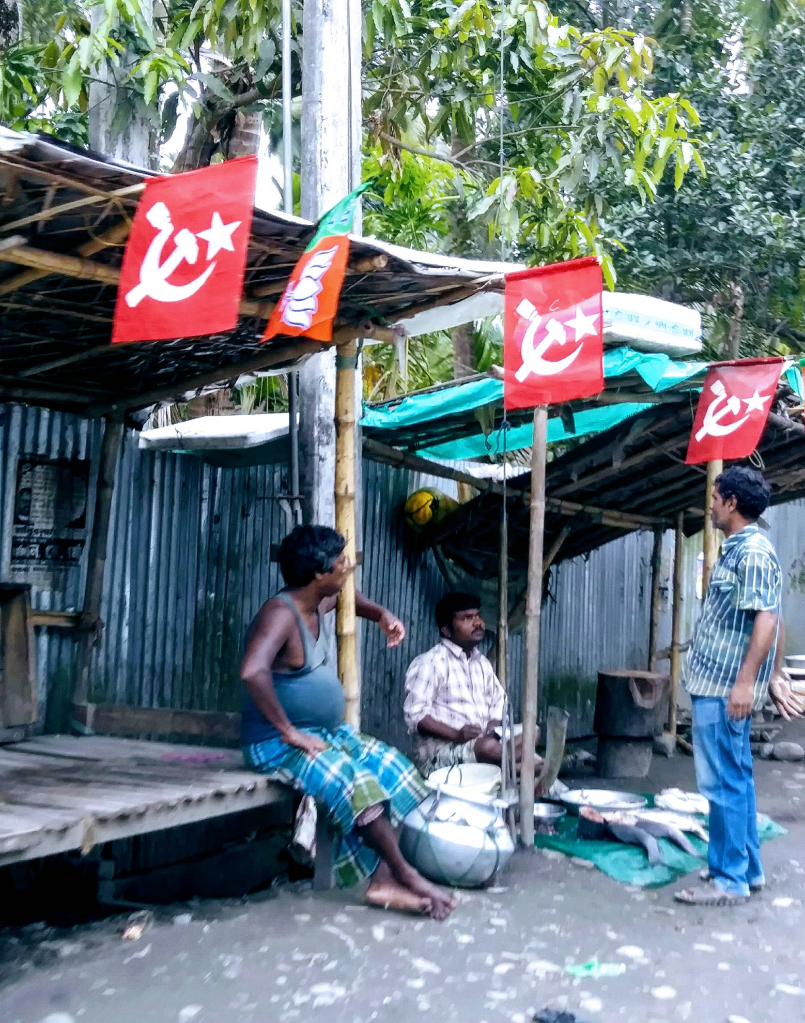
Breaking the orange-green-white mold, these are CPI(M) flags — Communist Party of India (Marxist) is the official name. But throw in a BJP flag too — just in case. By the way, the guy in the middle is a fish monger. Check out the boti, the standing knife in front of him — this is a larger version of a traditional type of knife that is still widely used in home kitchens for cutting vegetables, etc. It is set on the floor, and to use it you sit on the floor. People who are good at it are very fast. People who are not good at it avoid it!
The CPI(M) was founded in 1964, an offshoot of the CPI founded in 1925 (or so). They were elected to office in West Bengal in 1977 and governed the state for over 35 years until the voters threw them out on their keisters about five years ago. (I pass a “Naxalbari, 24 km” sign every morning on my way to campus — that’s where the Maoist Naxalite movement started in the 1960s.) No one seems to think the CPI(M) has much in the way of “legs” anymore, but they still “do their thing” (as the picture above attests) and provide some colorful opposition to the BJP in particular.
“No voter to be left behind.” So don’t leave your ID behind!
There was a loud — a very, very, very, very loud, albeit very small — campaign rally across the street from my flat last night (I thought it was happening in my bedroom, but I checked and it was across the street). I was afraid the same thing might happen tonight, but I found out that all electioneering has to stop 48 hours prior to the election. And polls open about 36 hours from now. I’m excited to see the polling itself — no mail-in ballots in these parts, you have to show up! Voting will be complete on May 19, counting and results announced on May 23.
(Katie, I will be watching to see if the campaign flags get taken down after elections are over… I have a guess…)













 A Northwesterner in North Bengal