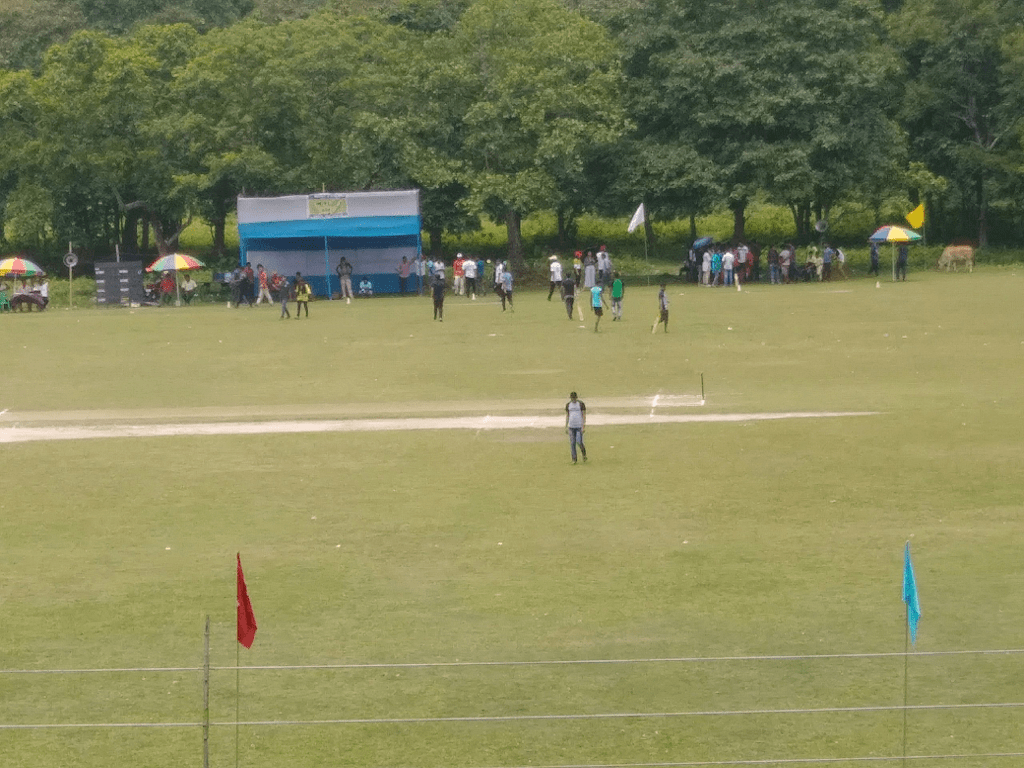
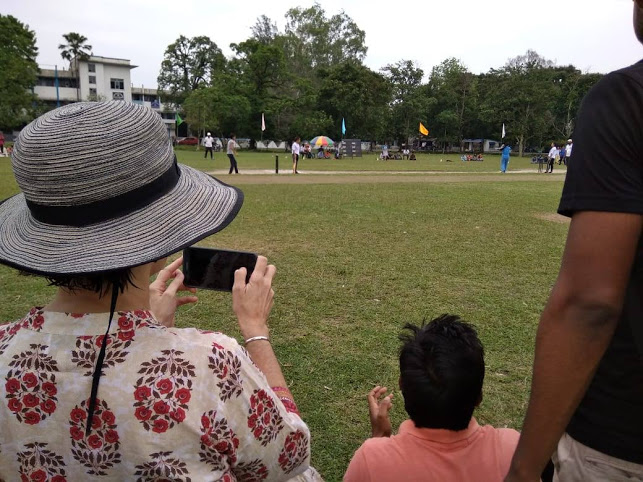
The History Department men’s cricket team just won their cricket match against the Commerce Department men’s team in the NBU Intramural Cricket Tournament. That’s great news! Almost as exciting, I finally, finally have more or less figured out the basic rules of cricket. And I will share those basics (my version of them) with you! I also now understand why I have never been able to crack the cricket code before. The first problem is that people always say that cricket is “like baseball”. In fact it is not at all like baseball. Yes, you hit a round ball with a long object. But on that basis you could say that cricket is “like golf” because the similarities practically end there. Secondly, I’ve only seen cricket on television before. The way the camera zooms in on the action means you don’t get to see the overall field, and so it is difficult to track the general trajectory of the game.
So here is my very basic version of the rules of cricket; I don’t guarantee 100% accuracy! But I think it’s more or less correct. Just for fun, I decided not to read online about the rules. What follows is what I was able to glean from watching and asking questions.
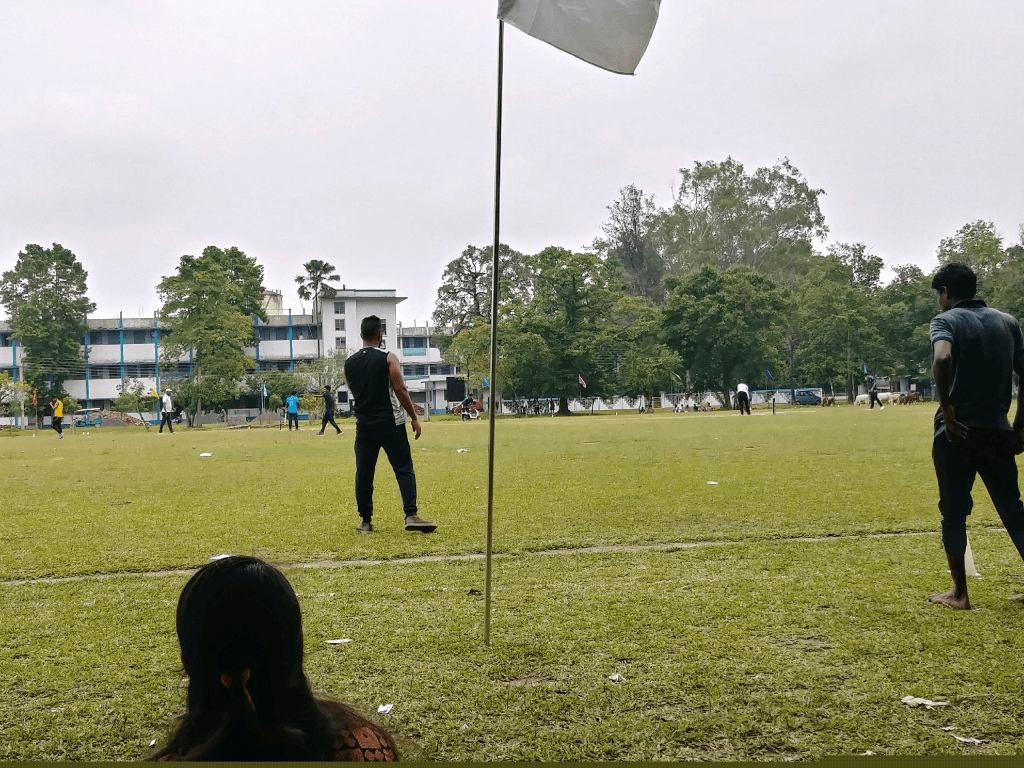
Cricket is played on a circular (maybe oval??) field. In the middle is the “pitch,” the long rectangular area where the bowling, batting and running take place. Fielders are posted around the field: in front of, behind and to the sides of the batter (from what I can tell, there is no such thing as a foul ball). At each end of the pitch is the “safe area” called the “crease” at the back of which is the wicket. The wicket consists of three stumps – tall stakes — pounded into the ground in a straight line atop of which sit two small pieces (of wood, I assume) called bails. The batter is protecting the bails from being dislodged from the stumps by the bowler. So when the bowler bowls, the batter defends the wicket by trying to bat the ball away. If the bowler succeeds in dislodging the bails, that is called a wicket. (Are you with me still?) A “wicket” refers to both the physical structure atop which the bails sit and also means “out”. When a player gets out – he (or she) is out of the batting line-up for the rest of the match. Two umpires are on the field at all times.
The match consists of two innings, and which team will go first is decided by a coin toss. (Hey! Cricket is just like baseball!) Each inning consists of a set number of “overs,” which in the case of the NBU men’s intramural matches is 14 overs, but can be 20 overs, or 50 overs (or I think any agreed upon number). In the most traditional type of cricket, matches are played over a period of five days (those colonials had a lot of time on their hands, apparently!).
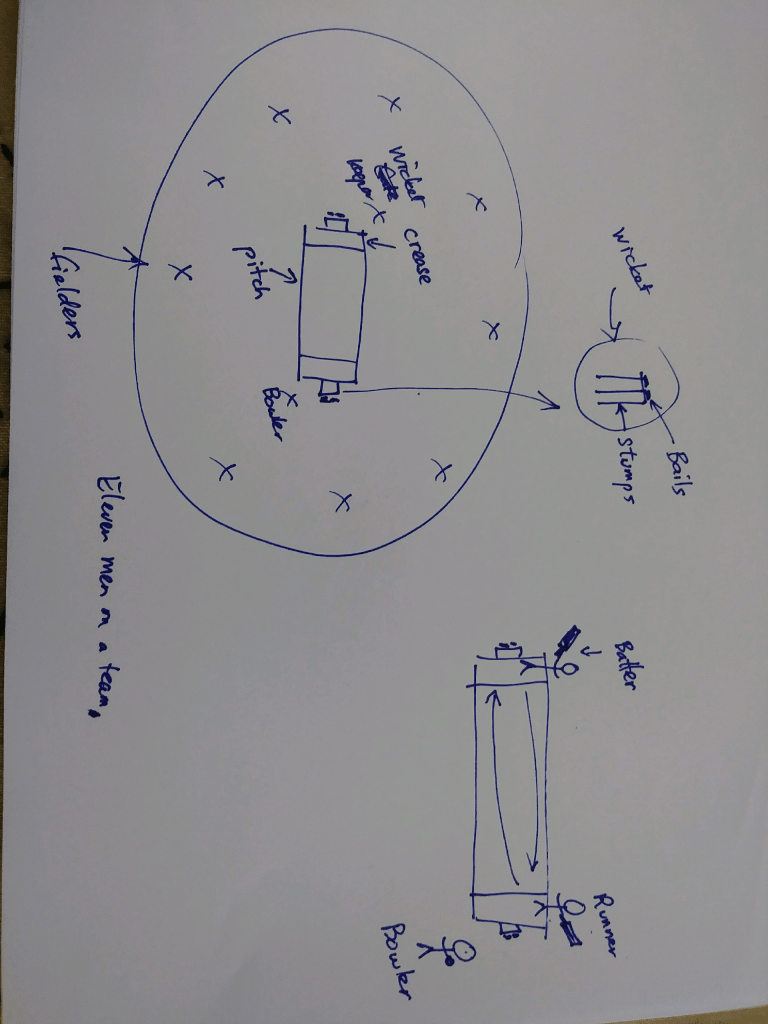
An over consists of six pitches – sorry, bowls – by the bowler. The batter bats at — tries for — all six bowls – if he strikes at the ball but misses, there is no penalty, he just tries for the next one. One of the umpires must determine whether the pitch is good or not, but I haven’t discerned the finer points there. If the batter makes a hit, he runs across the pitch to the wicket/crease on the other end of the pitch, and he must at least touch the tip of his bat behind the line of the crease in order to be safe – if the ball gets there before he does, he is out (again, called a wicket). As the batter runs to the other end of the pitch, another player, a teammate, who has been inside the crease at the opposite end also has to run, so as they run, they pass each other on the pitch. If it’s not obvious from where the ball has ended up after being batted, there has to be some communication (like a hand signal) between the runners as to whether or not they will run. If both runners successfully make it to the opposite crease, then that is counted as one run; depending on where the ball is, they can run back and forth multiple times. But if it looks like the ball can easily be delivered to the crease and get them out (it is only necessary to get one of them out), they will stop with one run. Not infrequently a batted ball doesn’t go very far, and the runners just stay put. (Unlike in baseball, the runner does not have to run after batting. Hmmm, baseball comparisons keep sneaking in here…) If the batter bats a ground ball that goes beyond the boundary without being touched by one of the opposing team’s fielders, that is four runs (the players don’t actually have to run them). If a fly ball is hit out of the field (what we would call a home run in baseball) then that is worth six runs. So those are the big payloads. Spectators shout, “Boundary! Boundary!” to cheer on the batter.
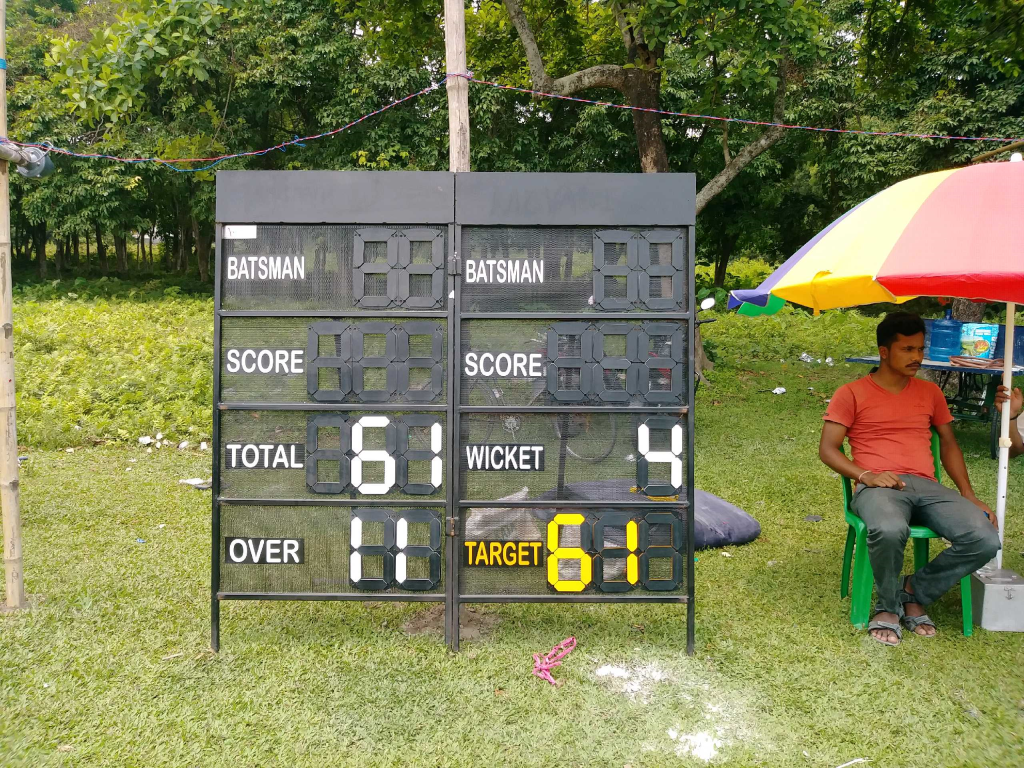
After one over (of six balls) the bowler switches to the opposite end of the pitch (whichever of the two batters/runners is in hitting position hits) but the batters can continue to bat as long as they don’t get out, or as long as the captain or coach wants to keep them batting (I think). (Kind of weird it’s called a pitch, when the actual “pitching” is called “bowling”.) The object of the game, of course, is to make as many runs as possible within the allotted number of overs. Once your inning is over, that’s it for your team. The other team is “up” and they have the same set number of overs to try to outscore their opponent. So it seems to me there must be a slight advantage to being up second, because then you know exactly how many runs (points) you are “chasing”. If and when the second team has bested the first team by one run, the match is done and the rest of the overs are not played. (Just like in baseball (there I go again!!) when the bottom of the ninth is not played if the team that would be up already has enough runs to win.)
Anyway, you can disregard all of that if you want to — it’s kind of like reading the rules to Monopoly but not figuring out how to play until you actually do it. The main point was in the lead – the History Department men won their match and now it is onward and upward! Go History! Beat English!

 A Northwesterner in North Bengal
Whoever invited this game, were they smoking something? I got to the point where oval might also be considered circular, and I was “yeah, I get this. I can do this! Mary is good at explaining things.” But then… pitches are bowlers and there are no out of bounds, and there are stumps that people want to dislodge with wickets (or maybe the opposite), and then a crease enters in, and you want to crease the wicket –or was it pitch to the wicket? –until you no longer have any overs left. It all sounds like its leading up to my nightmare GRE question that will surely torpedo any chance of mine of graduate school. (And was this game actually fun to watch?)
LikeLike
To answer your last question first — it was a blast to watch! But yeah, I figured things might get lost in the wash as I tried to explain the game. But I think you’d like it, Katie — after all, “It’s just like baseball!” The real question is this: If Runner A is running at a speed of 11 miles per hour and Runner B is running in the opposite direction at a speed of 12 miles per hour, which one gets to the Parkway Tavern first and how much does a beer cost once he gets there? I’m sure you can answer that and your GRE score will definitely get you into grad school at UWT!
LikeLike