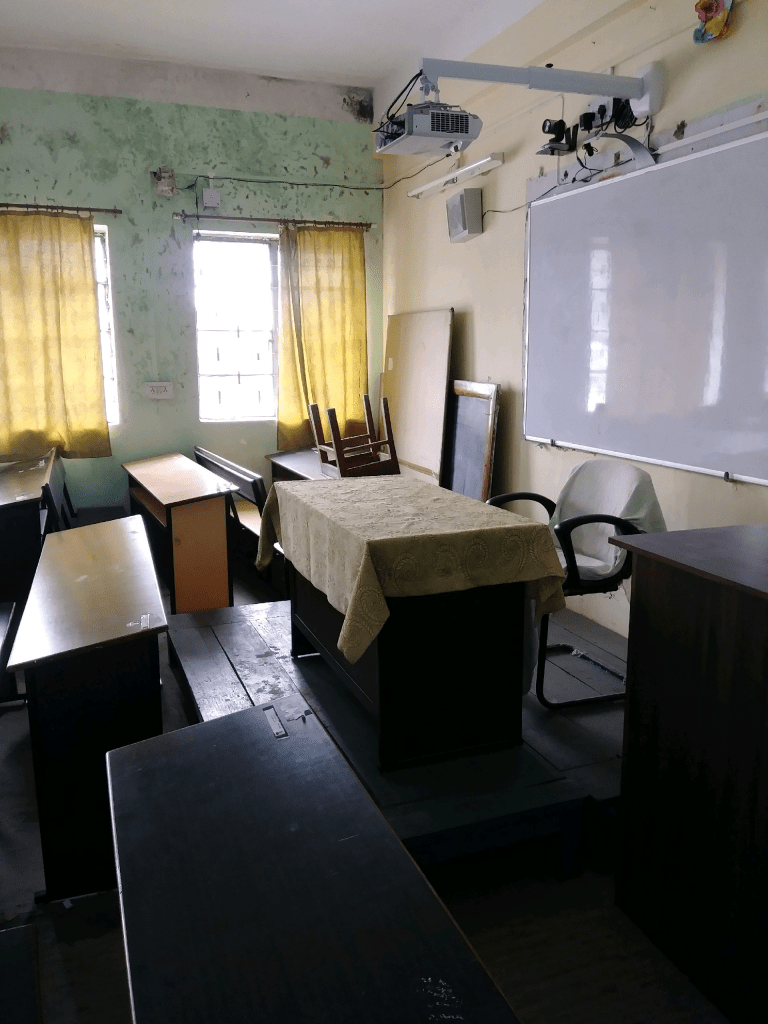
Students sit three or four to a desk.
I took my first class today! In Indian English that means I taught my first class. It was a Master’s level world history class and today’s topic was the Cold War (not my first choice of topics, but it was something on the pre-existing syllabus that I at least have some background on!). There are 105 students enrolled in the class. Today 45 came. That means that 3/7th of the students were in attendance (I did the math). So next week, when I teach in the class again, I will see – more students? Fewer students? Approximately the same number of students? I will report back.
Because I’m curious – did they find the class educational? Surely there is a novelty factor in having an American instructor, but I wonder whether they felt that what I taught was “news they can use”. The education system here is very solidly based on an examination system. At the end of each term, students have to take a standardized essay exam – all students in the University of North Bengal system, which means students at approximately 50 colleges throughout the region, have to sit for the same exam – and it’s a big deal. Last term’s exams ended a couple of weeks ago and the other day an article appeared in the newspaper about three students who took their exams from their hospital beds! (School officials were there to proctor – Indian English: invigilate – the exams). Anyway, where I’m going with this is that the exams are serious business. And, they are based on what is a quite standardized set of information. As a result, my ability to contribute to student success on the exams, and therefore in their college careers, is somewhat limited because I don’t really know how to teach to the exams – I don’t know what information they need. And they know that. The approach of many (most?) professors and students here is that the professor reads off their prepared set of notes and the students copy down more or less verbatim what the professor says. So… yeah. I don’t know whether the students will be back in significant numbers because I don’t know if what I have to give them is educational in the way they want it to be educational. (I should add that in any event, even if I could teach to the exams, I don’t want to teach to the exams; if there is any “value added” in my being here, it is not in my teaching to the exams.)
I was expected to take roll, which is very important here because unless a student attends at least 75% of the course meetings, they are not allowed to take the exam. The reality is that attendance tends to be very poor, largely because many students rely on “tuitions” – studying with private tutors – to prepare them for the exams. So there is almost a shadow education system made up of private tutors and a lot of students therefore more or less blow off the college and university system and just attend the mandatory 75% of the classes and expect to get their “real” education (viz., preparation for the exams) from tuitions. Having said that, the 3/7ths of the students who did attend my class today seemed very bright, interested and engaged. I enjoyed them.
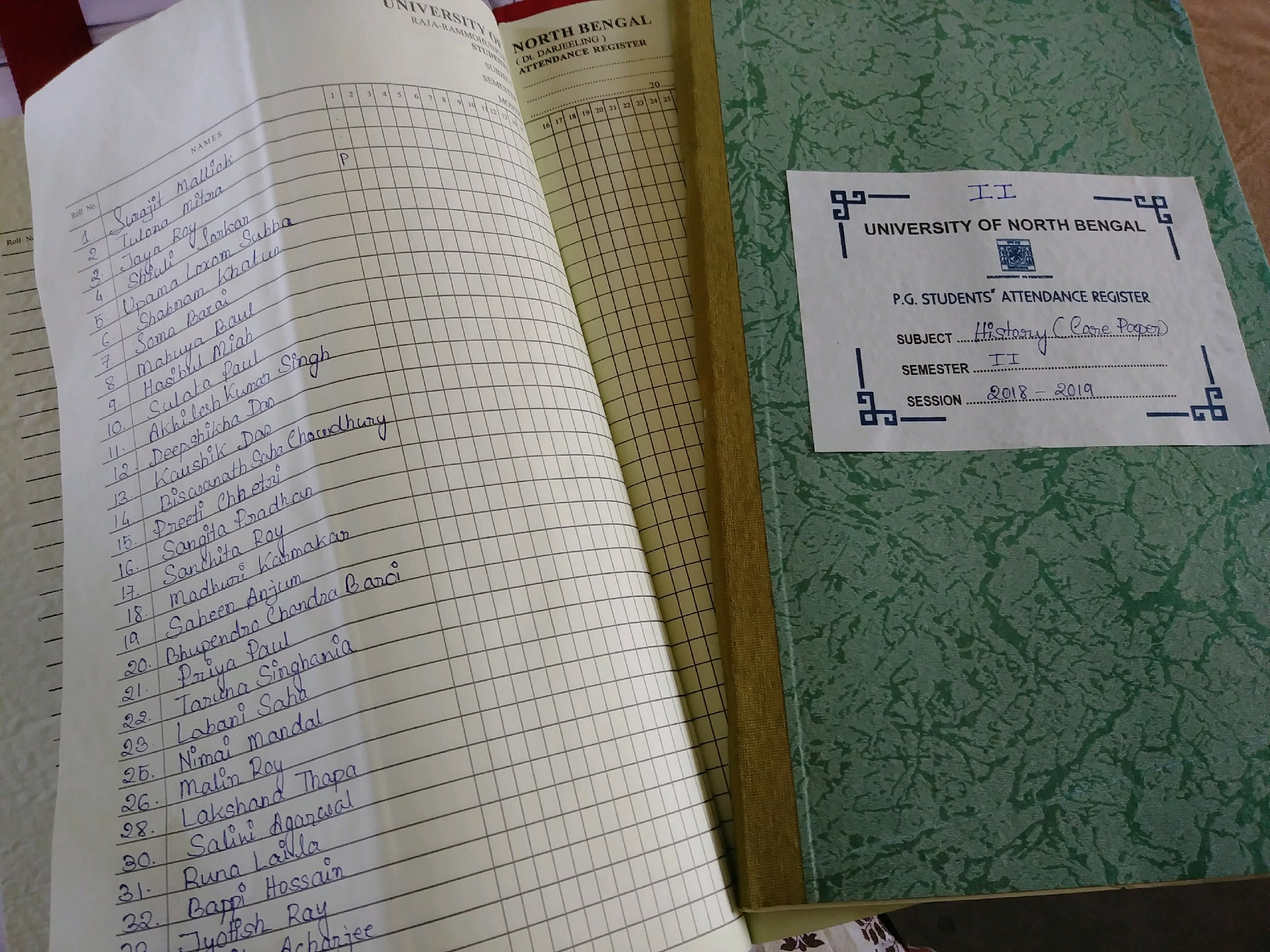
But about taking roll. Yikes. I didn’t want to spend seven or eight minutes of class time going through a list of names. One of the students volunteered to manage the attendance book after class. So, okay, no problem and thank you.
The courses at NBU are taught in English, not Bengali. That is a huge kettle of fish right there. One rationale for this is that students may come with a variety of mother tongues and by teaching in English it allows all to participate. Or not. I know the students have a hard time with my American English and I have a hard time with their Indian English.
I told the students that I would run the classroom like I would run a classroom in the US. This means: they do not have to stand up when I enter the room; they do not have to stand up when they ask or answer a question; they do not have to get my permission to enter the room if they are late and they don’t have to wait for me to exit the classroom before they do. (Come to think of it, when I’m back in the US, I think I will tell my students that I am going to run the classroom like they do in India.) It further means that I expect them to come to class on time. (I don’t think I can write about the differences in time culture between India and the US, the subject is really too painful.) What got the biggest reaction was when I told them they could eat in class – I doubt that any will take me up on it, much as I always enjoy seeing what students bring to class to eat. The way the classroom is set up, I have to teach from a dais at the front of the room, otherwise I would not be able to utilize the white board. This particular dais is a rather large, saggy, creaky, wooden affair. The sagginess and creakiness are alarming – I wonder if it will train me to stand in one spot while I teach. I had distracting visions of crashing through the wooden planking mid-sentence, dupatta fluttering and legs flailing while making some supposedly authoritative pronouncement about the Cold War.
We also talked (“we” meaning that I talked and they nodded with what I hoped was the recognition of engaged history nerds) about how the interpretation of history always depends on one’s vantage point and that as a result, I expected that I, as an American historian (not a historian of American history, but you know what I mean) would have different views and interpretations than they, as Indian historians (you know what I mean) would have – and that is what could help make our time together especially interesting.
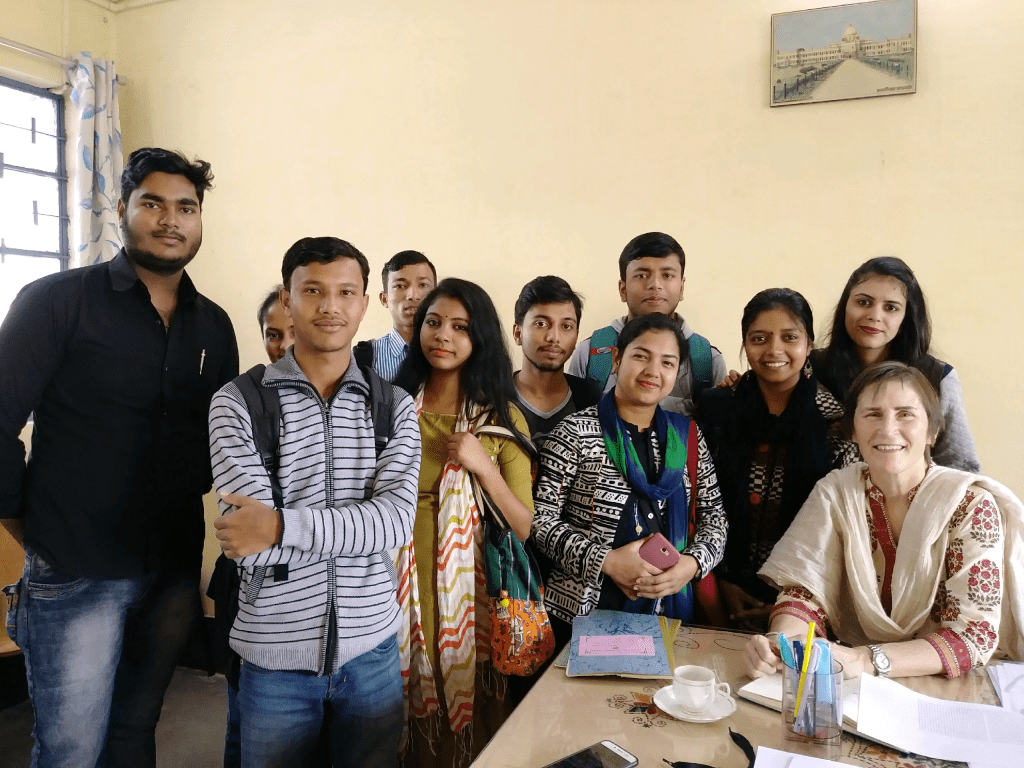
I was somehow happy to learn from them that people in India also think history is boring. I told them that in the US when I tell people that I teach history, the frequent reply is, “Oh. I hate history.” (This is actually true – people do say that! To my face!) They said, “Oh, here too.” Not that that is a good thing, but it is nice to find we have something in common – all of us engaged in a besieged discipline that people sometimes regard as the academic equivalent of having a root canal. A bonding moment on my first day of teaching.

 A Northwesterner in North Bengal
Awesome post – I feel like I’m there! And the roll-taking issue sounded daunting. How do you deal with the fact that one student is in charge of noting the presence of other students? Just curious. 🙂
LikeLiked by 1 person
Thanks Ellen — it’s a little more complicated because the roll books were not prepared in time and she (the student) volunteered to fill in the roster of names after class. She then asked everyone to write down their roll number on a sheet and turned the sheet of numbers in to me, and I recorded their attendance in the roll books — you can see in the pic that each student has a set number. Now that the books are prepared, I will circulate them in class for students to mark their presence. There may be some fudging, but I am not too concerned about that, since I am only teaching some of the class sessions over the term. The student was not alone, there was a group present during the whole process.
LikeLike
Mary,
I don’t know if this email return link will get to you or not….hope so. I have read most of your post. Your latest I find very interesting. Isn’t funny how people like you and me find history so very interesting and others find it boring. I don’t see how they get to that conclusion.
How long will you be teaching in North Bengal? What an interesting adventure it must be. If you could see me, I’m green.
Hope you get this and I look fwd to reading your next update.
Take care,
Ron
LikeLike
Hi Ron – thanks. It always surprises me when people don’t like history too. But I think a lot of it boils down to having had bad history teachers.
LikeLike
great post!!!!!!!
LikeLiked by 1 person
Another fun & interesting post! Can I share this one with a former student of yours?
LikeLiked by 1 person
Hi Ellen – of course, no prob!
LikeLike
I’m enjoying your lessons!
LikeLiked by 1 person
Thanks Nancy! No exams!
LikeLiked by 1 person
Wonderful post and great pictures! I find it interesting you are more traditionally dressed than the students. Is this generational, or is western wear more common in school? I wonder what subject it is most common for former students to say “oh, I loved xxxx!!” I love your wooden dais, although I can see how distracting it would be. The exam situation sounds like Spain. Teachers tended to be uninspired, and students skipped class and attended a private academy to teach them how to pass the test. While the university technically was free, it really wasn’t since students felt the need to attend these parallel classes. And, some professors had a second job where they worked at those academies! Anyway Mary, keep ’em coming!
LikeLike
Katie, re: your comments: Yes, generational. But yesterday, I wore jeans. I tried them on in the morning just to make sure they still fit — after over two weeks of being fed by other people. They did, so I wore them. I didn’t “take” class yesterday, but still, my students must have noticed. When I walk down the corridor, they move to the side and stop while I pass saying, “Good morning Ma’am,” or “Good afternoon, Ma’am”. Kind of like UWT — ya know? And yes, it does sound similar to the situation in Spain. What accounts for that? To be discussed over a bottle of wine….
LikeLike