When I am in India, I usually wear Indian dress, which for me means salwar-kameez. Salwar are the loose cotton pants, tapered around the ankle and held up with a drawstring around the waist (murder when you have to pee right now! ). Kameez (related to the word chemise) is a tunic-like top that usually comes to below the knee. Salwar-kameez is generally worn with dupatta, the long, wide scarf that drapes across the front of the chest, the two ends hanging down in back. (If the ends become uneven, it is called choto-boro – small-big, and it’s time to balance yourself out!) The purpose of the dupatta is to cover the chest — handy when you’ve had reconstructive breast surgery and are re-living adolescent self-consciousness about your breasts! – but the dupatta also lends an elegant and graceful finish that ties the ensemble together.
The other option for women’s dress in India and particularly Bengal is, of course, the sari. Many women wear sari daily here, whether they are professional women or house maids (maid-servants) or even if engaged in manual labor like hauling bricks! Of course, there is a huge range in types of sari, from very dressy and elegant silk to plain cotton. The sari, as most probably know, is a piece of fabric usually about six feet long by three feet wide. Under it, women wear “petticoats”, essentially ankle-length cotton half-slips with drawstring waists. The sari fabric is tucked into the waist of the petticoat, and then wrapped around the body, with pleats in front. The end, the decorative pallu, is gracefully draped over the left shoulder. Beneath the sari, in addition to the petticoat (which is not to be seen) is the midriff-baring, tightly-fitted blouse, which fastens in front with a series of hooks and eyelets. Given the conventions of female modesty in India, westerners are usually surprised that the sari leaves the midriff exposed, although it is possible to wrap the sari in such a way as to mostly cover the midriff.
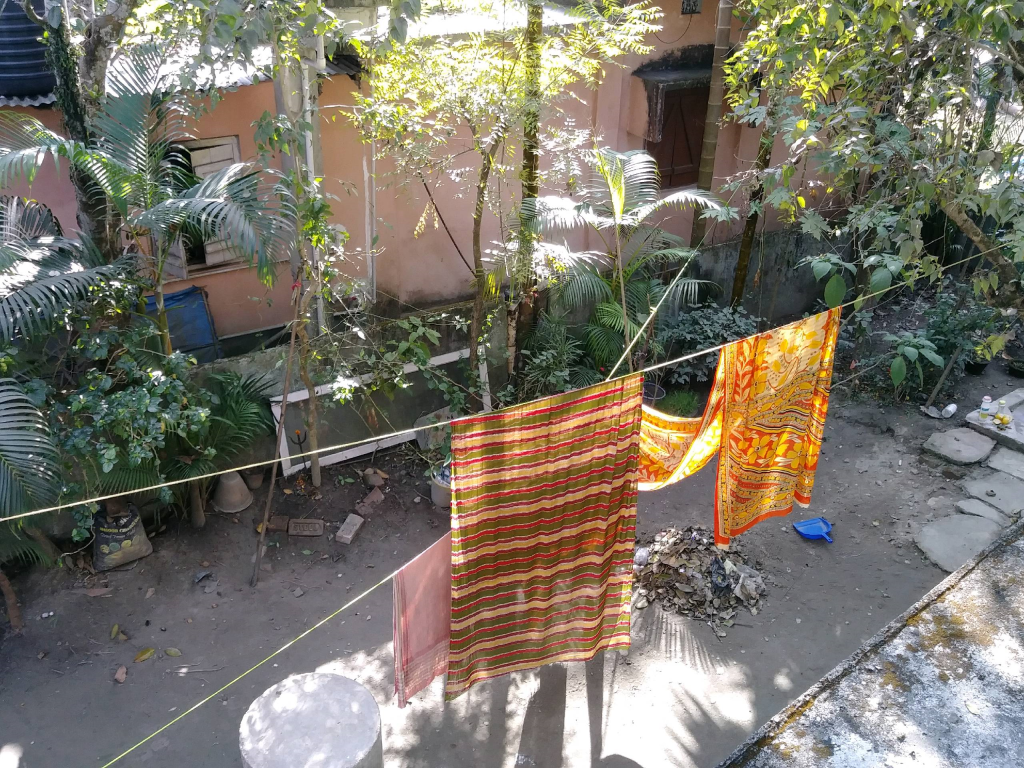
I have worn sari before on occasion, but it is very difficult – impossible – to pull it off gracefully when you are accustomed to wearing jeans and tennis shoes. Also, the petticoat is horribly uncomfortable: since it is the infrastructural element on which the whole thing literally hangs, it has to be cinched very tightly around the waist (and because cotton drawstrings stretch easily, you’re well-advised to start out with that thing really tight or you might soon find yourself adroop!). Although most women here can easily dress themselves, to get me dressed in a sari takes one if not two assistants! It reminds me of when my mother tied the bows in the back of my dresses when I was a girl; I hated it so much I would stamp my feet in anger! To tell the truth, I’ve had to exercise great self-control to prevent myself from doing just that while I’m in the process of being wrapped! Wearing sari for me feels like being in costume – which is basically the case – and I can’t feel comfortable, always afraid something is going to unravel and there I’ll be, exposed in blouse and petticoat.
But I wonder, what does it mean for me to wear Indian dress here? What am I saying to myself and to the people around me? My observation is that people either really don’t notice that much – because what else would a middle-aged woman wear if she’s not wearing sari? Or maybe they appreciate that I am wearing Indian dress because it somehow implicitly shows respect for the local culture and customs? Or they are too polite to say – why are you doing that? Why are you not just wearing jeans and tennis shoes?
If I were younger (or if I were in a more metropolitan area) I think I would be less likely to wear Indian dress, but I feel it is the appropriate thing to do here, reflecting my age and status. Coming from the US, where we usually don’t openly recognize status and instead adhere to an ideal (if not a reality) of equality, it is an odd feeling to recognize and acknowledge my own status here, status based on my age, my profession, my position, my education, my relative wealth; and most fundamentally, a status based on something I have nothing to do with and which absolutely eclipses those other markers of status – my race and my nationality – being a white American. As a white woman in the U.S. I already have a great deal of privilege; I sometimes wonder whether being a white American in India – I am “Madam” here – is the closest thing I will ever experience to being a tall, white male in America: I am noticed, respected, listened to, deferred to – and perhaps occasionally resented.
It’s delicate to find a middle ground between on the one hand acknowledging and understanding my status here, while at the same time, trying to step out of it and bring some of what I see as essentially “American,” to my experience and interactions by transgressing those status boundaries. Of course, it is only due to my privilege that I can try to transgress those boundaries if I so choose. Choto-boro — keeping my dupatta in balance. The old question, “What should I wear?” carries a lot of freight.

 A Northwesterner in North Bengal
Mary, just wanted to let you know that one can type in the title of your blog in Google, and wind up here (so people can get here and comment) Dave
LikeLike