Bathrooms

Not my favorite room.

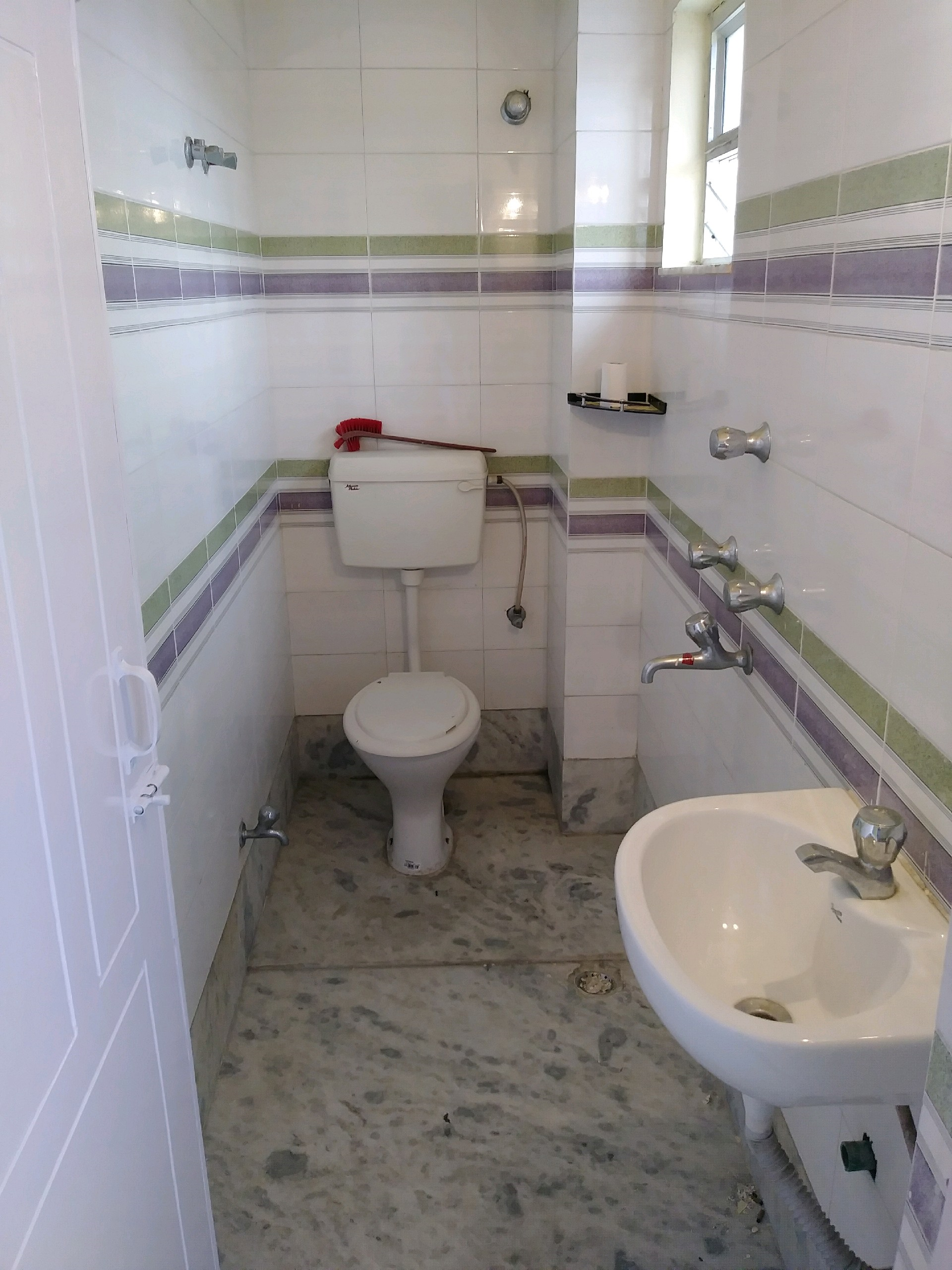
As promised (did I promise?) here are pictures of my two bathrooms.  Neither of these is my favorite room in the flat.  The one with the western toilet is in my “master” bedroom, the other one opens onto the main part of the flat.
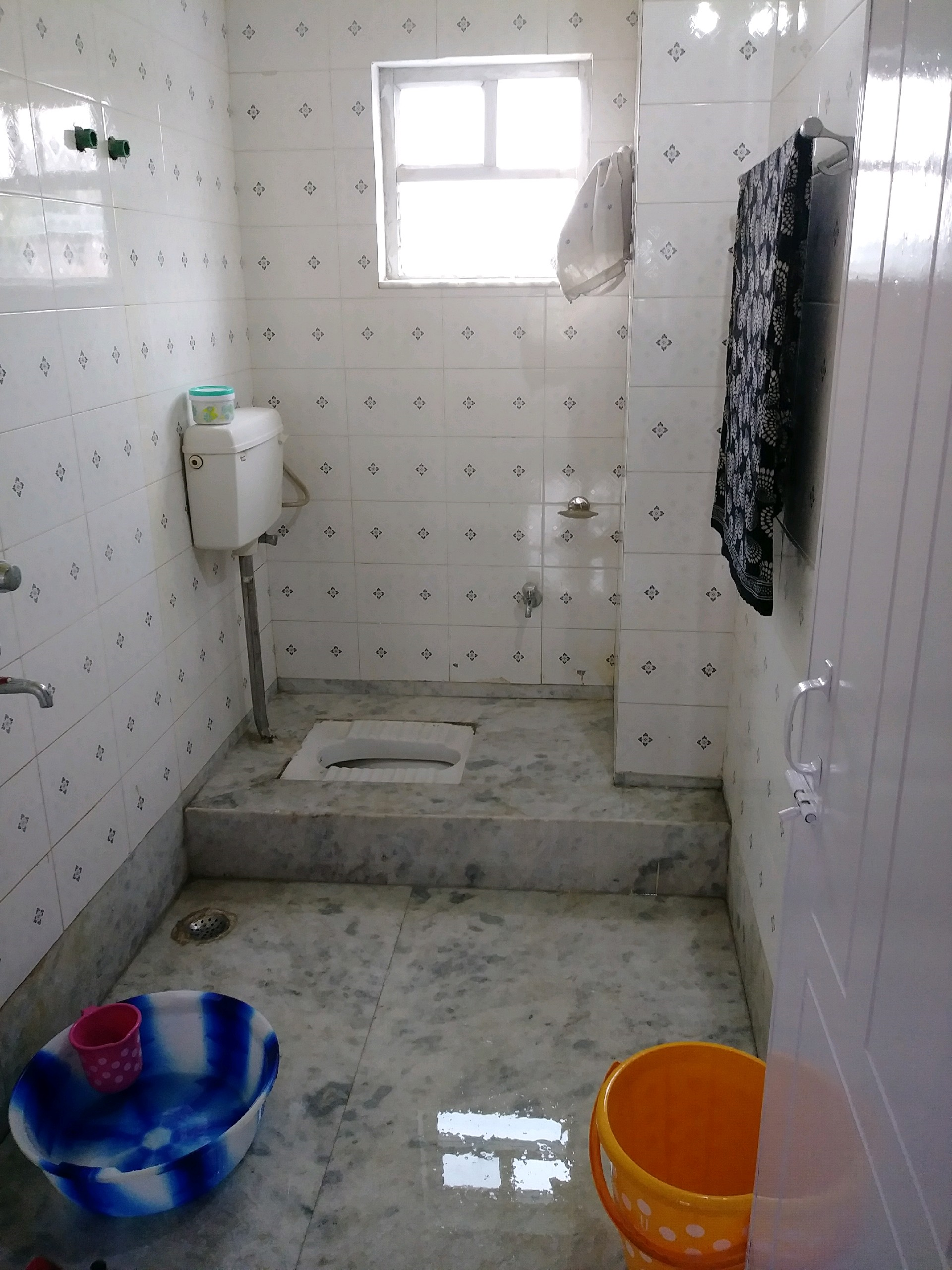
Also not my favorite room.

As you can see, the floor of the larger bathroom (above) is wet — because before I took the pics I did some laundry, and also bathed.  The orange bucket I use for my laundry; the blue basin, with the pink polka-dotted dipper, is for bathing.  High up on the wall on the left are a couple of green pipe ends — these for connecting an instant water heater, a “geyser” as they are called here (pronounced “geezer”).  I don’t have a geyser (or a geezer) — but I do have an electric kettle.  Two kettles full of boiling water mixed with tap water in the basin makes for a nice hot bath. Three kettles full is luxury.  

A number of years ago Caroline and I met a British gentleman in the train station in Calcutta.  Don’t ask me how, but the conversation turned to bathing and how we bathed in our accommodations in Maynaguri, the small city where we were staying.  When we described the process he gaped at us wide-eyed and said, “You mean to tell me that you actually bathe in a bucket??”  (Only Caroline can accurately imitate his accent!)  Bathe in a bucket? Well yes, kind of.  And no, not really.  I mean, you don’t actually get in the bucket, you just use the water in it to pour over yourself.  

I follow some important bathing guidelines — number one, I don’t open my mouth when I bathe (please don’t drink the water) and secondly, I wash and rinse my hair first.  Probably everyone has their own rules (contrary to the “Bathe in a Bucket Brit” story, it is not a common topic of conversation, so I don’t know for sure).  But I wash hair first while I have a definite supply of hot water. Because although it is possible but not at all pleasant to rinse your body with cold water, pouring cold water over your head?  Yikes and double yikes!  

But talk about a falling hazard!  A smooth, wet, marble floor?  Scary!  A number of years ago I fell sprawling onto the floor while stepping down from a raised in-floor toilet platform (that sounds a bit odd — look at the picture, you can see how the in-floor toilet is actually raised above the rest of the floor).  It is a wondrous thing indeed that I didn’t break an elbow, a knee, suffer a concussion or knock out a row of teeth!  (My imagination only travels in one direction — disaster.)  Needless to say, I tread gingerly on these floors now, usually wearing a pair of “shower shoes” — flip flops. 

If you have any suggestions as to what I can do to make these bathrooms more delightful places, I welcome your ideas!
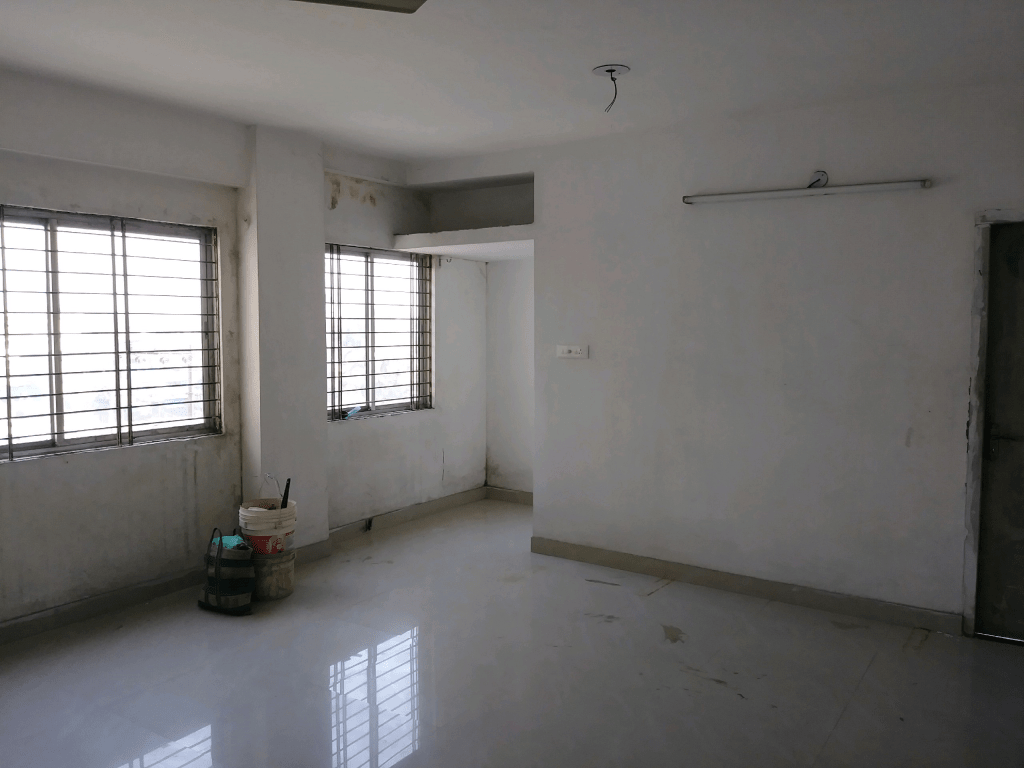
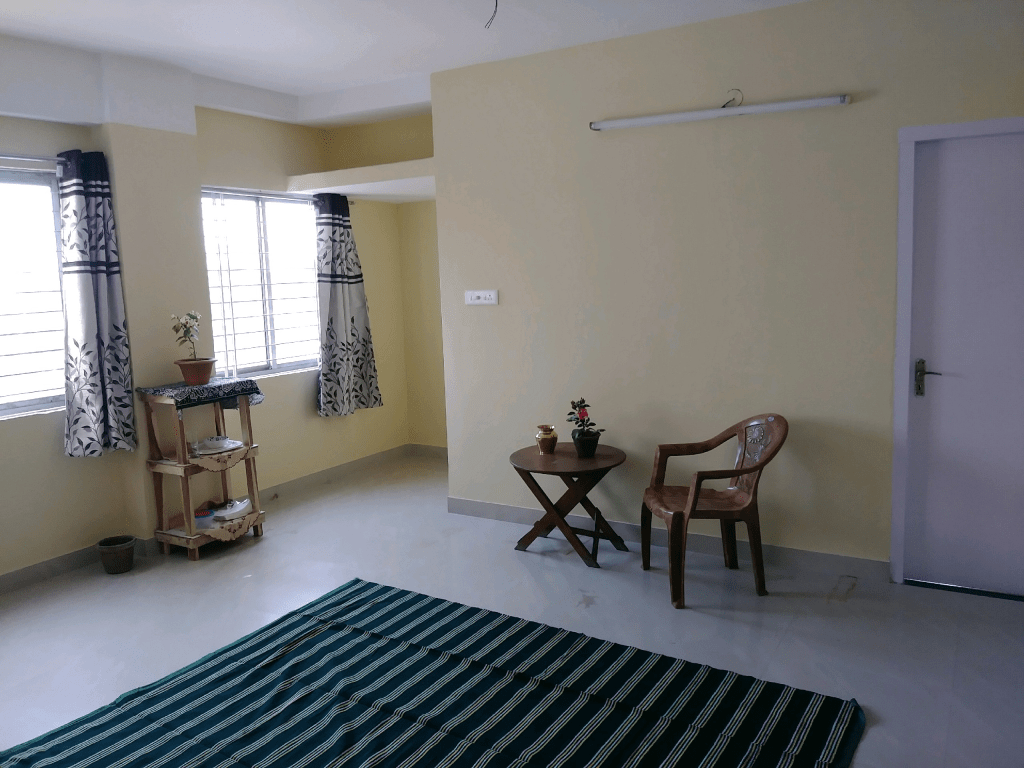
Before and After

Looking at the main room of the flat from the front entrance.
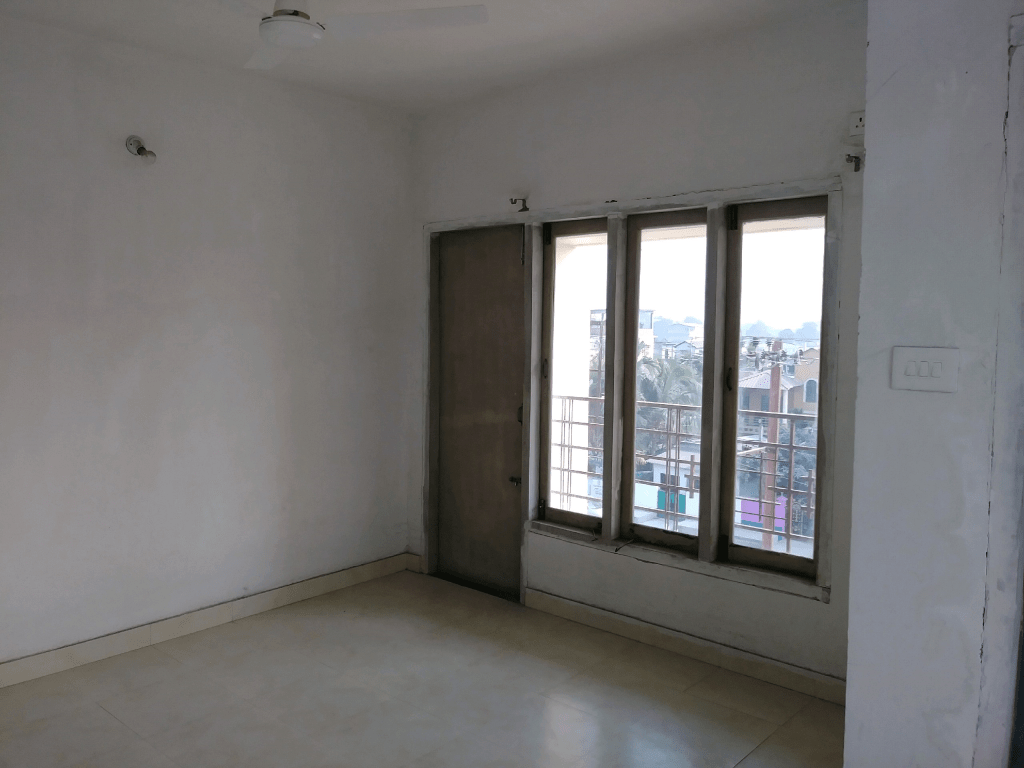
Main room, same perspective as above. The windows face north. The door is to the “guest” bedroom. (The flat has three bedrooms, but one the owner uses for storage and is locked.) As you can see, I finally have a plastic chair, my very own plastic chair. I could have gotten red, but I opted for “wood”. On the opposite side of the room from where the chair is, I have my dining table — yes, a plastic table! Also “wood”!
Main bedroom, windows and balcony face east.
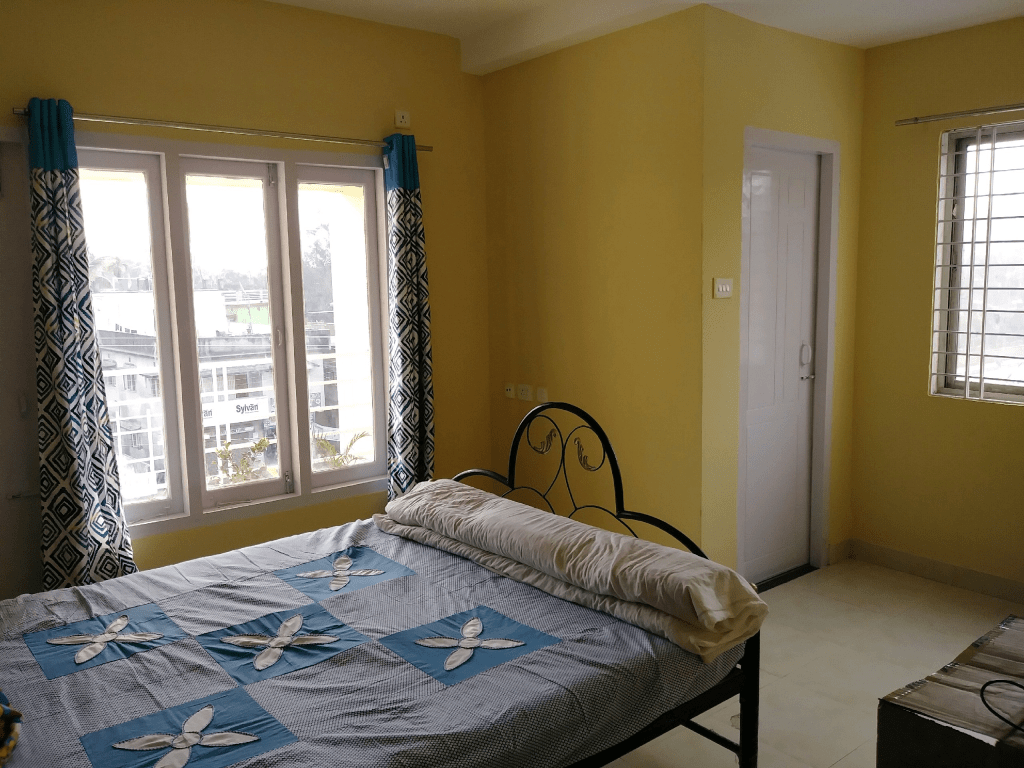
My bedroom. The door goes to a small bathroom. The previous picture was taken looking northeast, this picture is taken looking southeast, from the entrance to the bedroom. In the lower right-hand corner you can see part of the shelving unit I made out of three stacked cardboard boxes. I’m quite proud of it! I got some plants the other day — they are on the balcony — two small palm trees and an orange tree. The orange tree has a bunch of small oranges on it — the size of large marbles! When I first brought the plants here I kept them inside, thinking it was too cold for them to be outside, but then I realized, duh, this is their natural habitat, they want to be outside! From this eastern exposure, if it is ever clear, I will be able to see Mt. Kanchenjunga in the Himalaya Range, the third highest peak in the world, only 860 feet shorter than Everest.
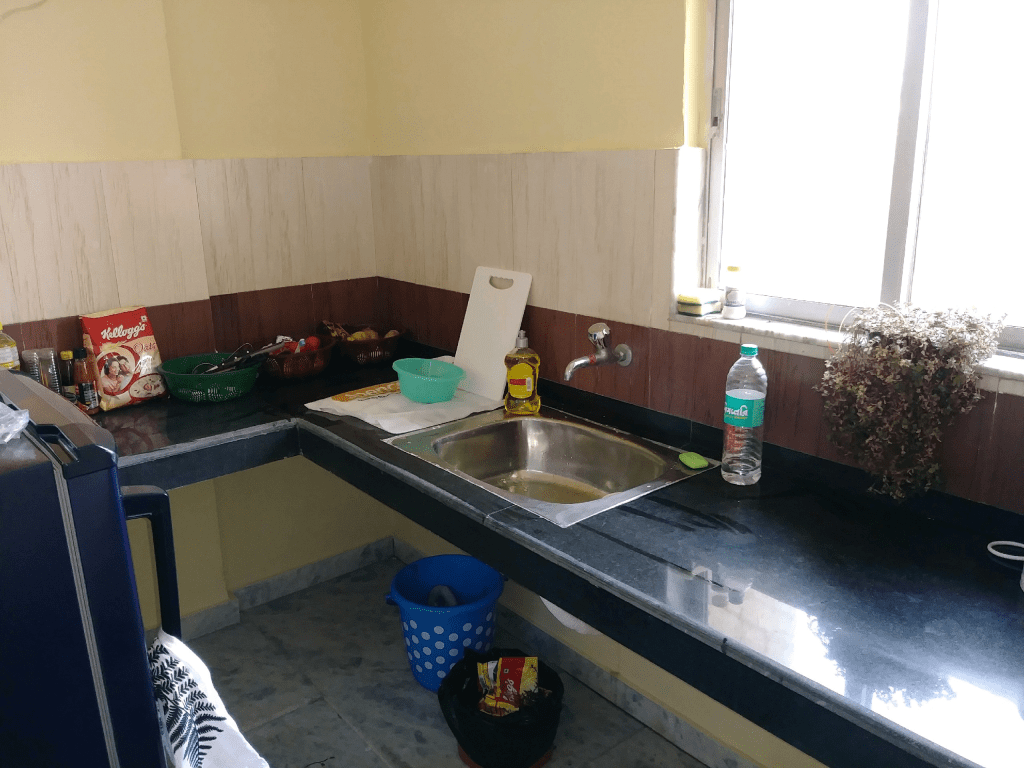
Kitchen. I don’t have a “before” shot of the kitchen. That bushy thing on the windowsill is a plant I am trying to nurse back to health.
My flat-mate.

I didn’t include pictures of my bathrooms (I have two!). Do you want to see pics? Yes, you do? I’ll post some later.

It’s a Lock

Last Friday I arrived at my office around 10:00 a.m. Since things don’t usually get started around here until about 10:30 or 11:00, I thought I’d have some quiet time to get a few things done.

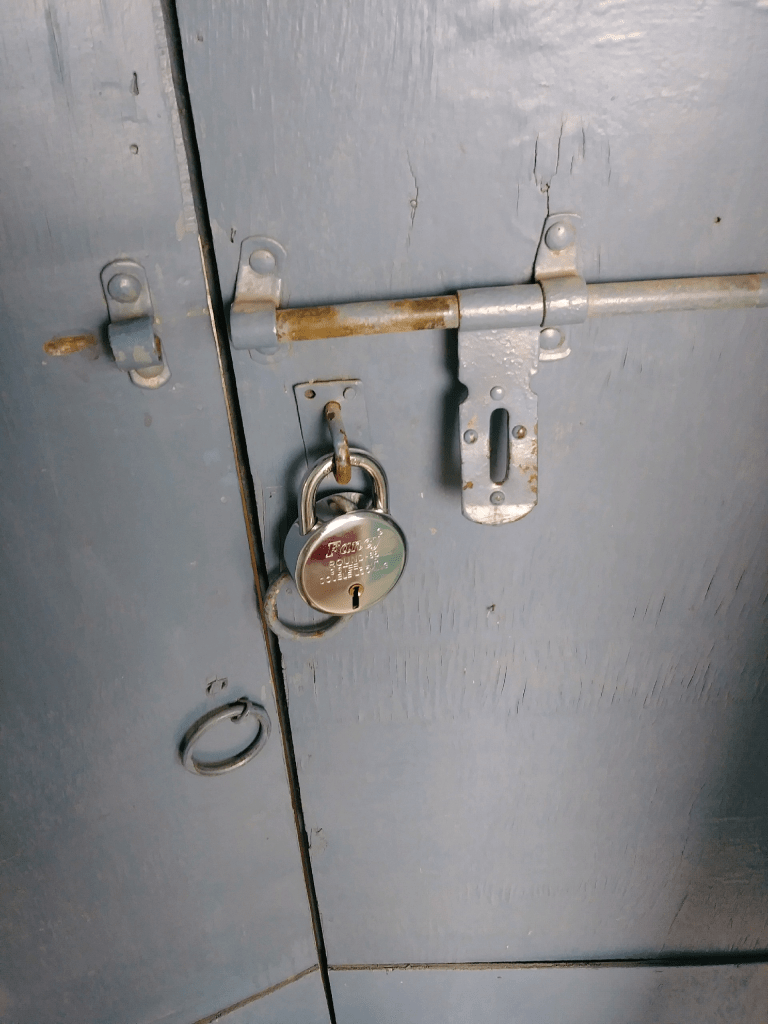
But when I tried to open the padlock on my door, it was jammed tight. What to do? I sat down to wait for someone to arrive.

After about 20 minutes, Somnath, the peon, arrived. “Peon” is a job description here, not a derogatory term, and Somnath’s job is basically to take care of the History Department — from serving tea… to breaking locks!

I explained my predicament, and Somnath sent a student outside to find a good-sized rock. Rock in hand, he started beating the lock and after about ten well-aimed blows, it broke apart.

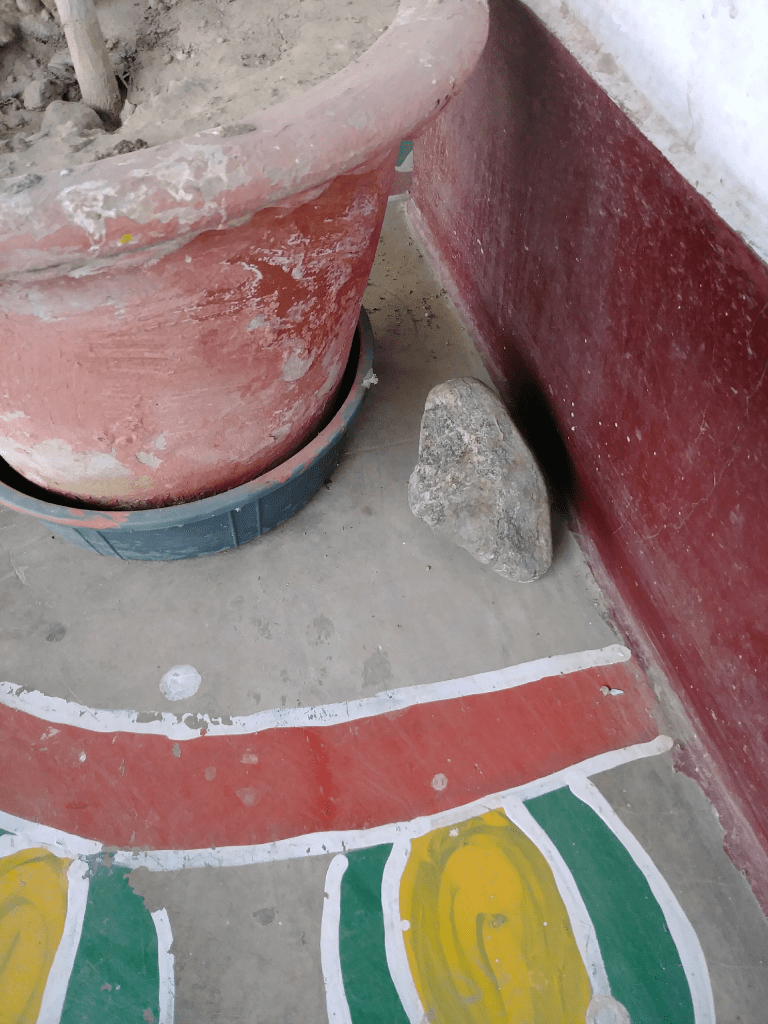
They stashed the rock here. It might come in handy sometime!

His act of violence complete, Somnath turned to me with a beatific smile on his face and said, “Ma’am? Only four months? Too short, too short.”

My new lock.

Later that day he delivered a new lock. But I’ve stopped locking.

Mukhe Bhaat

The first time a Bengali baby eats solid food, at around six months of age, it is an occasion for celebration, a celebration called Mukhe Bhaat – which literally translates to something like “Rice in Mouth”.  So today, when I boiled my first pot of rice in my “new” kitchen, I felt it was a kind of Mukhe Bhaat celebration for me. 

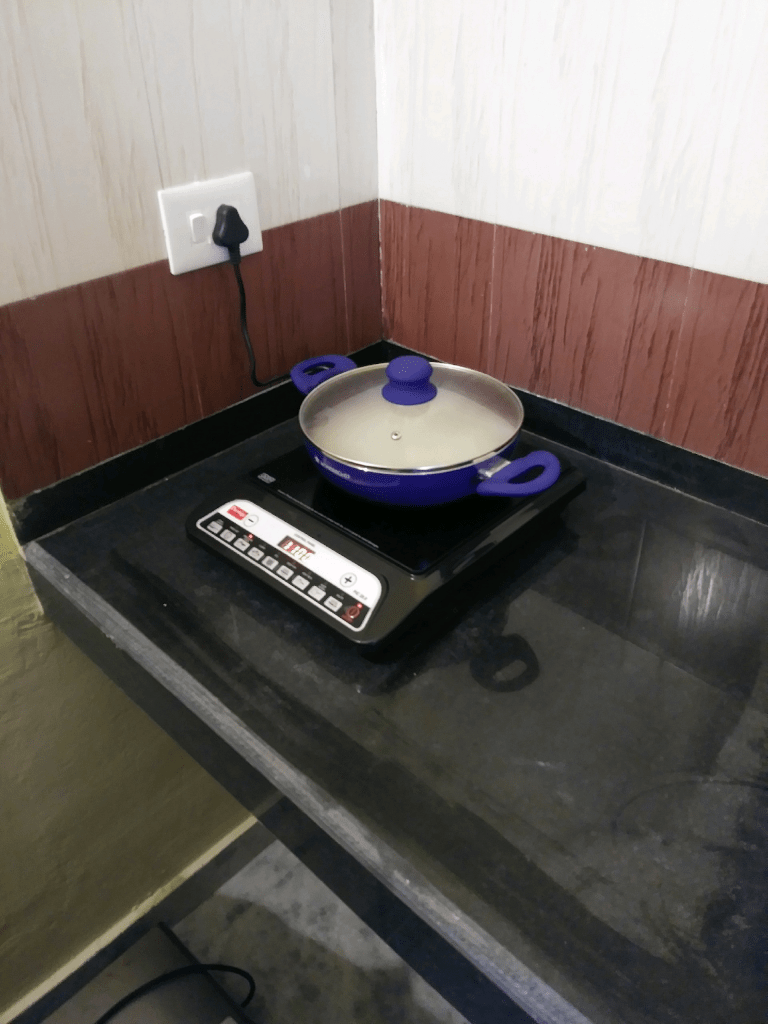
My hot plate, an induction burner (is that what these are called?). Most people here use gas rings, with propane tanks. I probably should have done that, but those propane tanks are huge and scary! Oh well. This looks a bit sad, but I’ve got purple pots!

I just moved into my flat – slept here for the first time last night. As promised, I’ll post some “before” and “after” pictures – but there isn’t really an “after” yet!  The move-in is still in process!

This morning, bright and early, the help started to arrive, first Poonam, the maidservant, who swept and cleaned my floors.  Then the two men who delivered my set up for drinking water, and finally the two plumbers who fixed the drain pipe to the kitchen sink. 

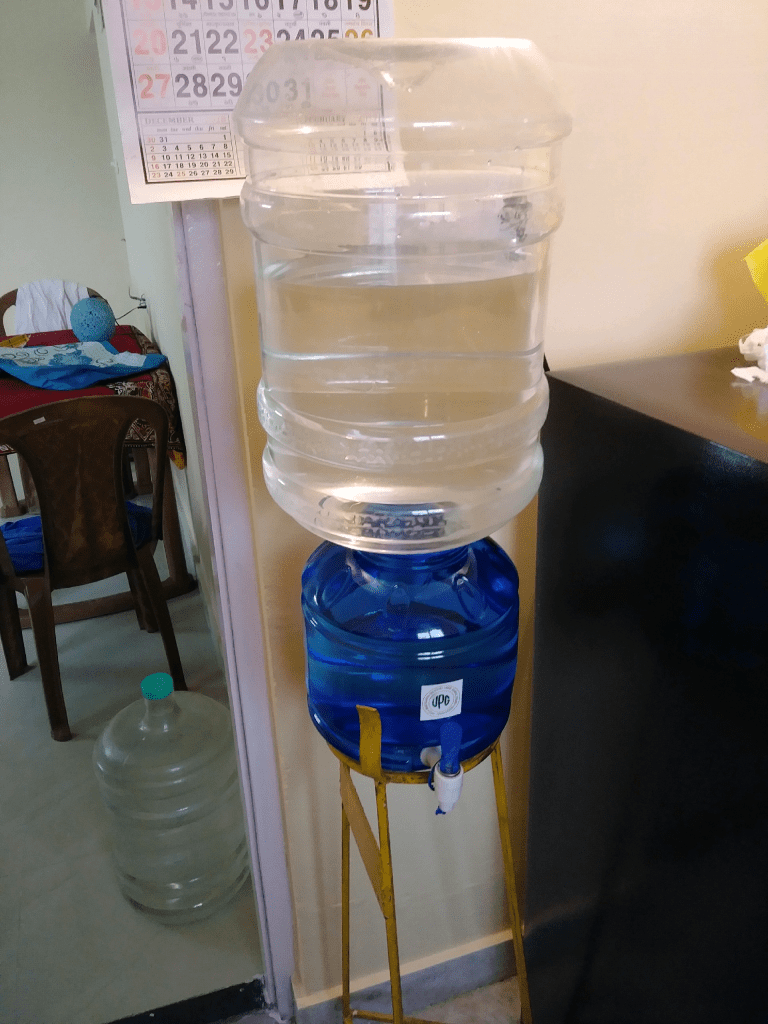
Drinking water. Tap water is not potable and it is full of iron — has a reddish color out of the tap. I’m not inclined to drink it even if I boiled it, but it is for bathing and washing.

Batting three for three – a remarkable record here, as friends Amitabha and his wife Sarbari would say.  Amitabha figured that if one out of three arrived this morning, I could count it a success.  India is not necessarily known for efficiency, so I had to agree with him.  And yet, we had just called each of these helpers last night – in the US you could call a plumber and expect rapid service – plumbing problems can be an emergency after all.  But you’d pay a pretty penny.  I paid my plumbers about $7.00 – that was for parts and labor. 

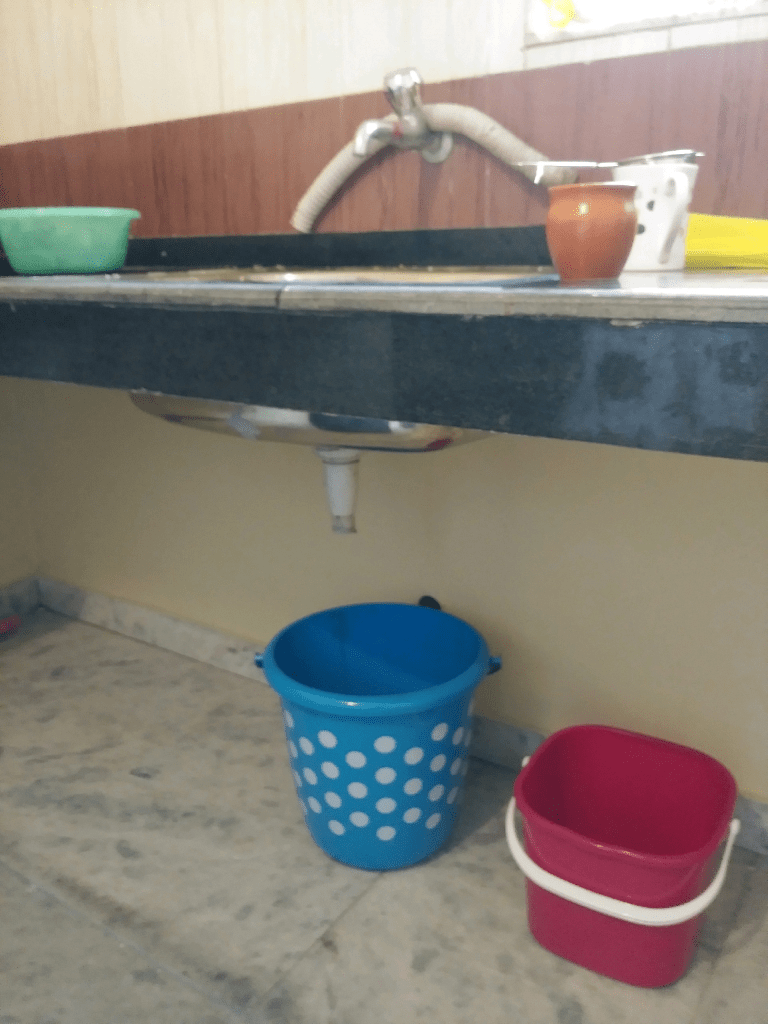
My system while I waited for the plumber to come. This worked fine, but the plumber’s version is much better! Just behind the blue bucket you can see the hole in the wall that the drain pipe feeds into. Not sure where the water goes from there…

Poonam, age approximately 22, with a five year old daughter and a husband who doesn’t work, brought a blithe spirit to my flat this morning when she arrived at 7:00 a.m.  She is a true beauty, tall, with sparkling eyes.  A few months ago, Amitabha told me, she had informed them she was moving to Mumbai for a job someone had promised her.  Amitabha and Sarbari suspected a trafficking scheme, and called the police.  The police quickly appeared at Poonam’s house, talked to her about her plans, and although it’s not like the police could have stopped her from going, she obviously re-thought the situation and she’s still here.  She did a beautiful job on my floors – I was supposed to pay her 100 rupees – I paid her 150 (100 rupees = about $1.40).  I would like to have given her more, but I’ve been told not to upset the apple cart too much.  On the other hand, when I leave, I can and will – it will be appropriate at that time – give her a healthy tip. Poonam doesn’t clean toilets, by the way.  The woman who comes on Sundays will do that.  The caste system lives on. 

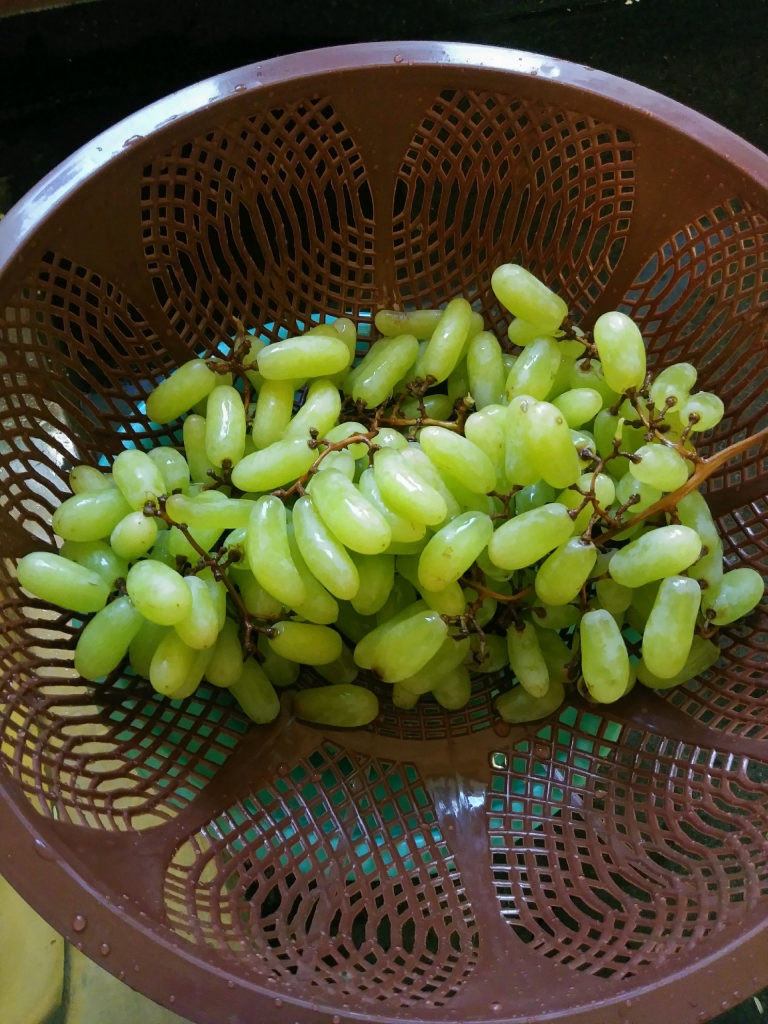
green grapes

Noblesse oblige lives on as well, and most middle class people employ “maidservants,” cooks, laundresses, drivers. Doing so is almost seen as a duty, a way to assist those less fortunate, of whom there are many. No surprise, I’m not accustomed to having people in my living space doing work that I could do myself, and it makes me feel self-conscious and antsy. But that’s my problem, not theirs. In fact, the relationship between servants and their employers is often quite close and warm. I think the water guys, the plumbers, and Poonam all kind of got a kick out of the novelty of working for the American lady. Tonight a guy was supposed to come install a mirror for me — there are none in the flat. He was a no-show. Three out of four — not bad!

Two Girls and Two Boys

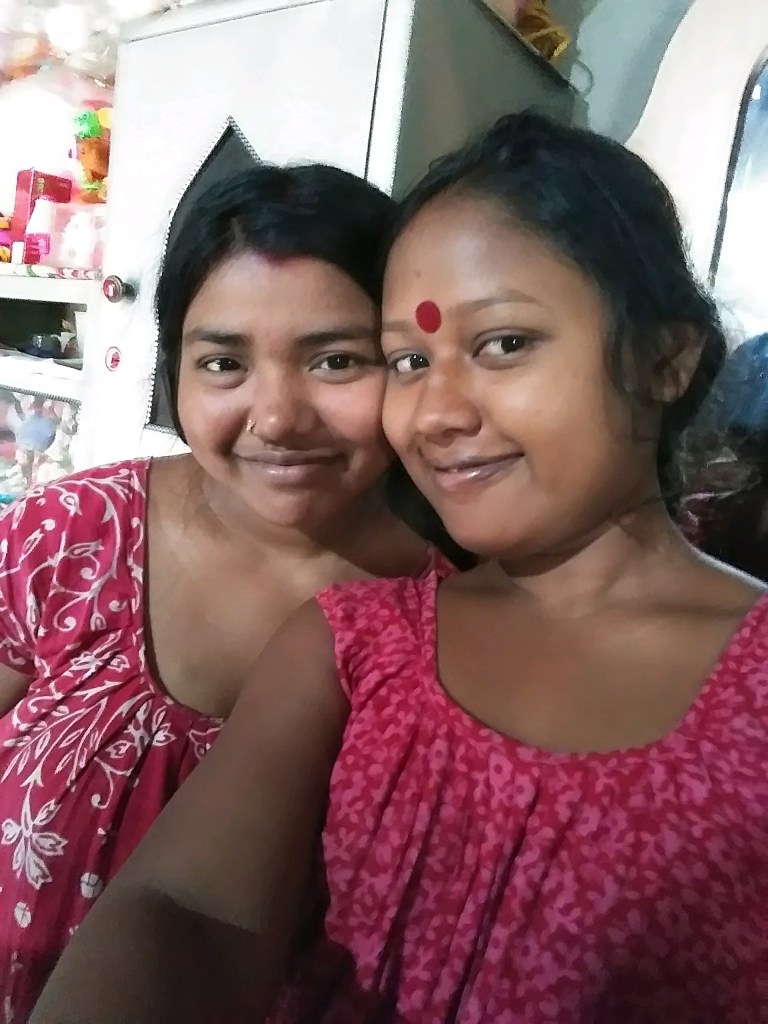
Rupali and Tuli (L and R), both 21 years old. They live in Maynaguri, where Caroline and I were in 2010, and are friends of Caroline’s. (I like them too!) Rupali is married now, the red sindoor in the middle of her forehead at the hairline is the mark of a married woman in Bengal. Tuli is not married; the bindi (called teep in Bengal) between her eyebrows is purely decorative.
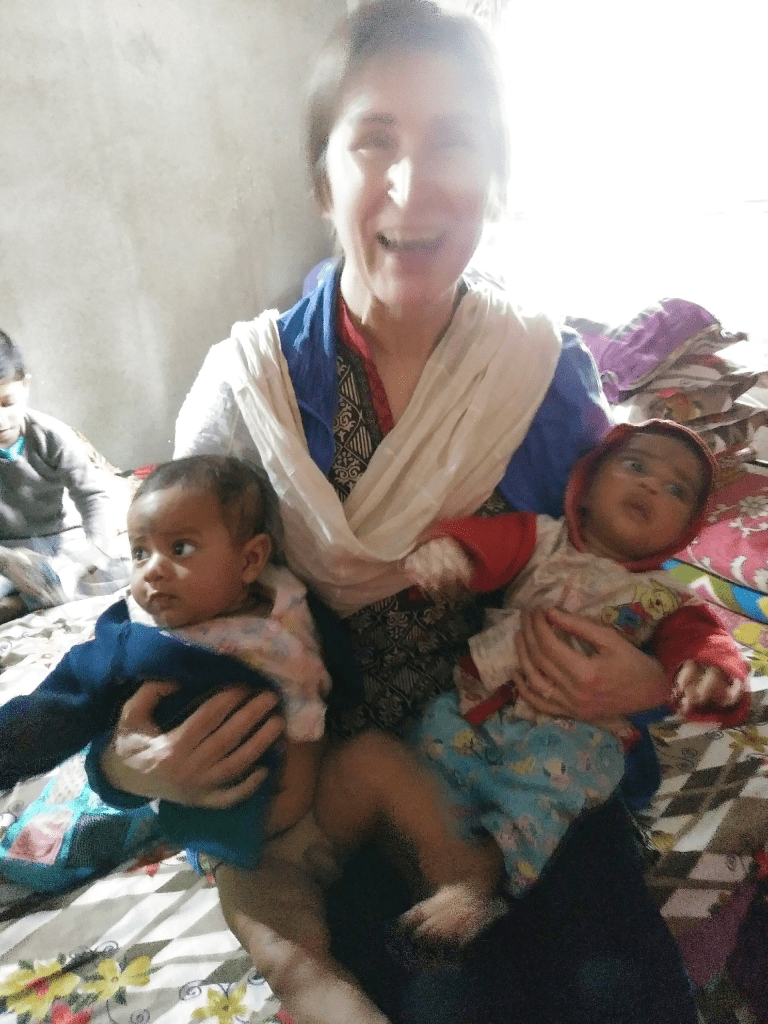
These are Rupali’s twin sons, about 5 months old.

First Class

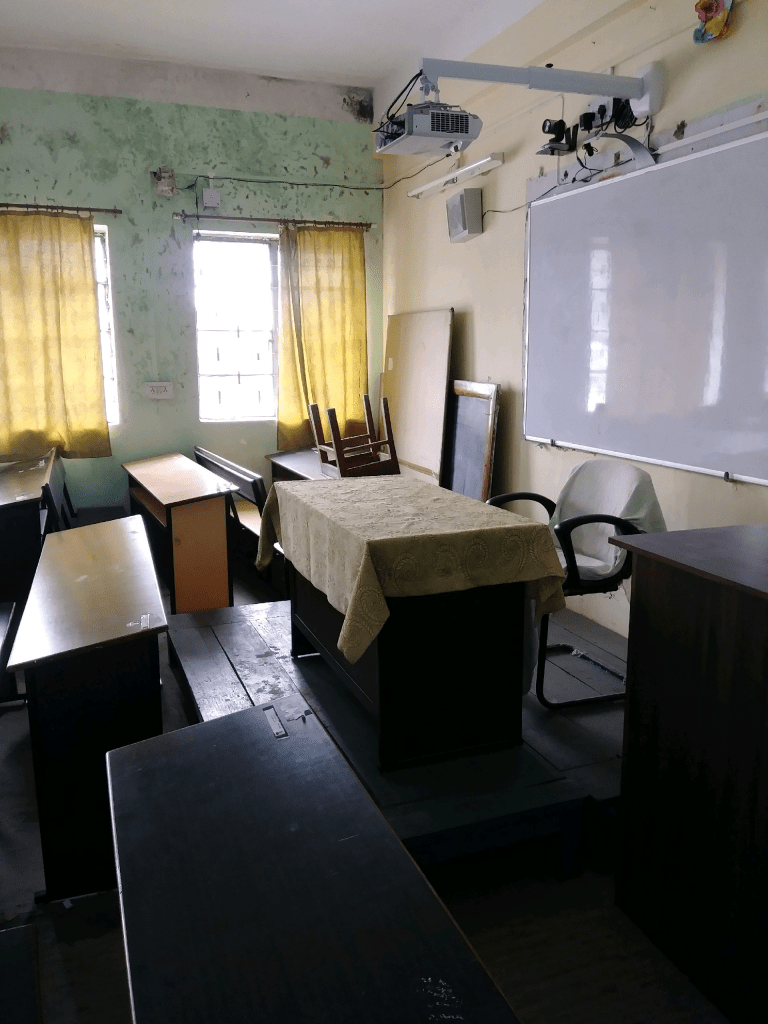
This is the front of my classroom. You can see the raised dais.
Students sit three or four to a desk.

I took my first class today!  In Indian English that means I taught my first class.  It was a Master’s level world history class and today’s topic was the Cold War (not my first choice of topics, but it was something on the pre-existing syllabus that I at least have some background on!).  There are 105 students enrolled in the class.  Today 45 came.  That means that 3/7th of the students were in attendance (I did the math).  So next week, when I teach in the class again, I will see – more students? Fewer students? Approximately the same number of students?  I will report back.

Because I’m curious – did they find the class educational?  Surely there is a novelty factor in having an American instructor, but I wonder whether they felt that what I taught was “news they can use”.  The education system here is very solidly based on an examination system.  At the end of each term, students have to take a standardized essay exam – all students in the University of North Bengal system, which means students at approximately 50 colleges throughout the region, have to sit for the same exam – and it’s a big deal.  Last term’s exams ended a couple of weeks ago and the other day an article appeared in the newspaper about three students who took their exams from their hospital beds! (School officials were there to proctor – Indian English: invigilate – the exams).    Anyway, where I’m going with this is that the exams are serious business.  And, they are based on what is a quite standardized set of information.  As a result, my ability to contribute to student success on the exams, and therefore in their college careers, is somewhat limited because I don’t really know how to teach to the exams – I don’t know what information they need.  And they know that.  The approach of many (most?) professors and students here is that the professor reads off their prepared set of notes and the students copy down more or less verbatim what the professor says.  So… yeah.  I don’t know whether the students will be back in significant numbers because I don’t know if what I have to give them is educational in the way they want it to be educational.  (I should add that in any event, even if I could teach to the exams, I don’t want to teach to the exams; if there is any “value added” in my being here, it is not in my teaching to the exams.)

I was expected to take roll, which is very important here because unless a student attends at least 75% of the course meetings, they are not allowed to take the exam.  The reality is that attendance tends to be very poor, largely because many students rely on “tuitions” – studying with private tutors – to prepare them for the exams.  So there is almost a shadow education system made up of private tutors and a lot of students therefore more or less blow off the college and university system and just attend the mandatory 75% of the classes and expect to get their “real” education (viz., preparation for the exams)  from tuitions.  Having said that, the 3/7ths of the students who did attend my class today seemed very bright, interested and engaged.  I enjoyed them. 

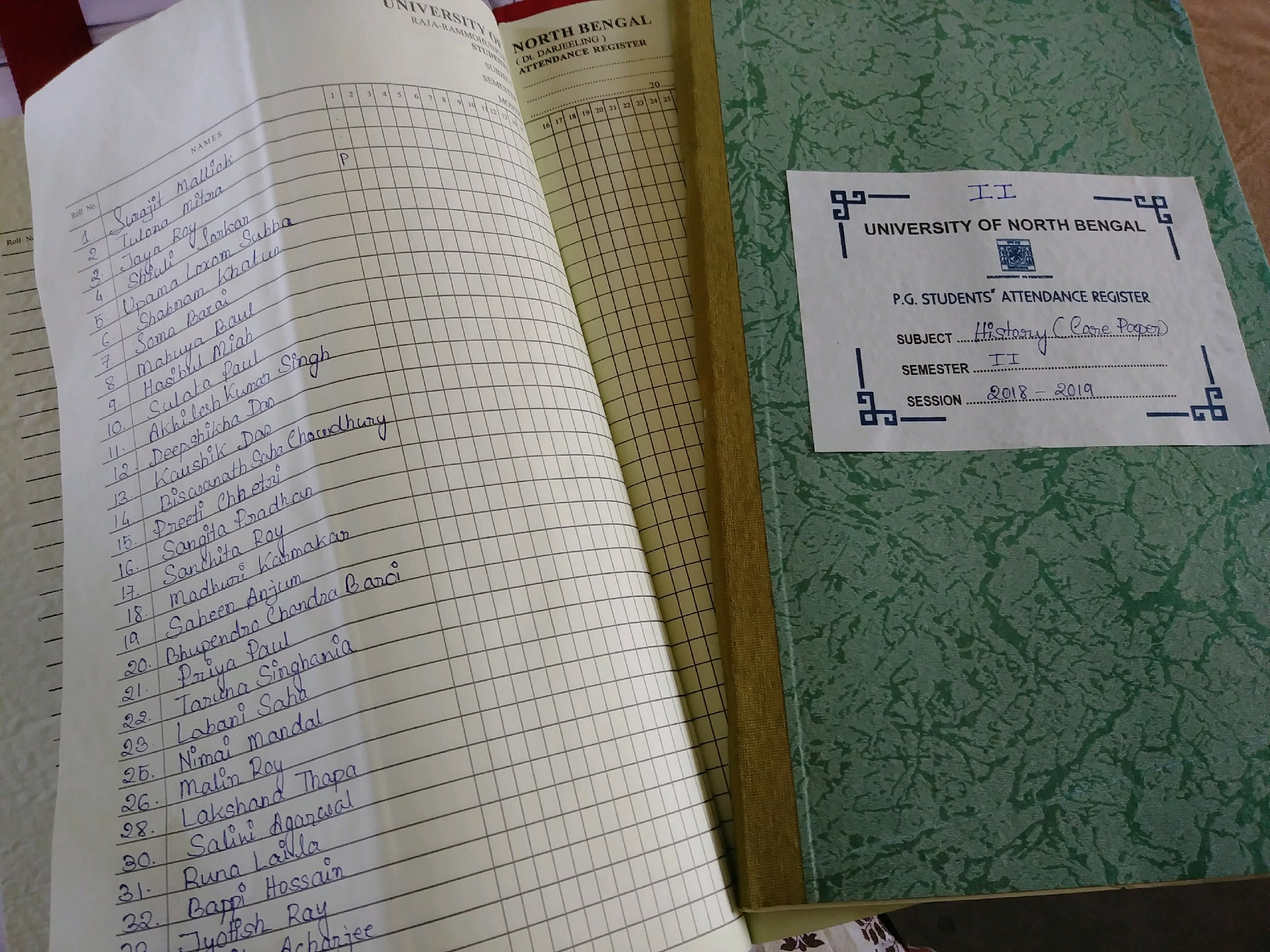
These are the books in which roll is kept. (Don’t read any of the names: FERPA!)

But about taking roll.  Yikes.  I didn’t want to spend seven or eight minutes of class time going through a list of names.  One of the students volunteered to manage the attendance book after class.  So, okay, no problem and thank you. 

The courses at NBU are taught in English, not Bengali.  That is a huge kettle of fish right there.  One rationale for this is that students may come with a variety of mother tongues and by teaching in English it allows all to participate.  Or not.  I know the students have a hard time with my American English and I have a hard time with their Indian English.

I told the students that I would run the classroom like I would run a classroom in the US.  This means: they do not have to stand up when I enter the room; they do not have to stand up when they ask or answer a question; they do not have to get my permission to enter the room if they are late and they don’t have to wait for me to exit the classroom before they do.  (Come to think of it, when I’m back in the US, I think I will tell my students that I am going to run the classroom like they do in India.) It further means that I expect them to come to class on time.  (I don’t think I can write about the differences in time culture between India and the US, the subject is really too painful.)  What got the biggest reaction was when I told them they could eat in class – I doubt that any will take me up on it, much as I always enjoy seeing what students bring to class to eat. The way the classroom is set up, I have to teach from a dais at the front of the room, otherwise I would not be able to utilize the white board.  This particular dais is a rather large, saggy, creaky, wooden affair.  The sagginess and creakiness are alarming – I wonder if it will train me to stand in one spot while I teach.  I had distracting visions of crashing through the wooden planking mid-sentence, dupatta fluttering and legs flailing while making some supposedly authoritative pronouncement about the Cold War. 

We also talked (“we” meaning that I talked and they nodded with what I hoped was the recognition of engaged history nerds) about how the interpretation of history always depends on one’s vantage point and that as a result, I expected that I, as an American historian (not a historian of American history, but you know what I mean) would have different views and interpretations than they, as Indian historians (you know what I mean) would have – and that is what could help make our time together especially interesting. 

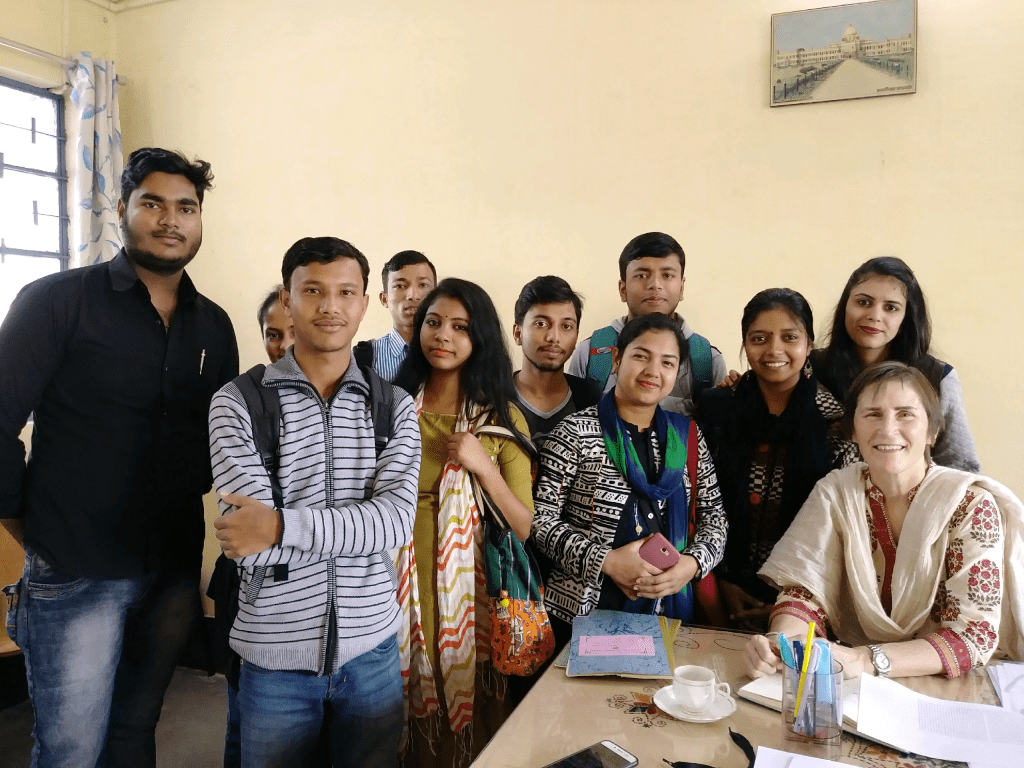
This group of students from yesterday’s class came into my office this morning to ask if they could take “selfies”. Such sweeties!

I was somehow happy to learn from them that people in India also think history is boring.  I told them that in the US when I tell people that I teach history, the frequent reply is, “Oh.  I hate history.” (This is actually true – people do say that! To my face!)  They said, “Oh, here too.”  Not that that is a good thing, but it is nice to find we have something in common – all of us engaged in a besieged discipline that people sometimes regard as the academic equivalent of having a root canal.  A bonding moment on my first day of teaching.

Hospitality

If love means never having to say you’re sorry, being in North Bengal means never having to say “thank you.”  People don’t commonly say thank you here – or I should say, they don’t commonly express gratitude by saying thank you.  Rather, to the extent one would express gratitude, it should be expressed via action – through attitude and behavior. 

But another undercurrent is at work here: saying “thank you,” implies the other person is not generous, that they would not be willing to bend over backwards for you and do anything at all for someone they care about.  It’s not exactly an insult, but it doesn’t speak well of your opinion of them.   

It is part of the hospitality culture that to my mind very nearly defines Bengali culture.  On any given day, it is common for people to drop by others’ homes for a visit at any time, and when they do, it is only natural to offer them – not just offer, but make sure they take – a cup of tea, a meal, a sweet (mishti – literally “sweet,” usually milk-based treats that Bengal is justifiably famous for).  On one occasion when I went to someone’s house with our friend Sam (Samarpan – he teaches English at Maynaguri College) Sam happened to have a bad stomach.  The mistress of the house offered him a snack, which he declined.  She offered again, again he declined.  Back and forth they went, with the end result being that even though she knew he had a bad stomach, she insisted he eat just half an omelet which she then freshly prepared for him.  To be polite, he complied.  That’s a tricky one, isn’t it – bending over backwards to be hospitable, to the extent that you actually are imposing on someone. I call that a case of aggressive hospitality! 

For the last few days I have been staying with Sam and his wife, Rakhi, and their nearly nine-year-old son, Riom (and Sam’s mother and father) at their house in Maynaguri, 45 kilometers and a rough, rugged two hour drive from Siliguri.  Maynaguri is the town, and Sam’s is the house, where Caroline and I stayed when I did my previous Fulbright in India in 2010.  In the few days I’ve been here, I have experienced Sam’s and Rakhi’s bend-over-backwards generosity in so many ways that I can’t even name them.  But one way that I can name came the day after I arrived, when it turned out that in order to complete the very complicated – and mandatory — process of registering as a foreign resident with the Indian government, I needed documents I had stupidly left behind in Siliguri.  Without missing a beat, Sam made arrangements for a driver to take us (me, Sam, Rakhi and Riom) back to Siliguri to get the necessary documents and then return to Maynaguri so that we would still be able to enjoy our time together. 

It’s pretty hard not to say thank you to that kind of generosity.  And yet at the same time, it’s impossible to say thank you, because it is so totally inadequate to expressing how much you appreciate someone and all they have done to love and care for you.  In fact, as I write this, I can’t help but think of the people who stepped up to the plate to stand by my side when I was going through cancer treatment.    People who literally and figuratively made me eat “half an omelet” when I could hardly bear to eat!  Sometimes aggressive hospitality is exactly what we need!  “Thank you” is all I can say, but it isn’t nearly enough.


“What Shall I Wear?”

When I am in India, I usually wear Indian dress, which for me means salwar-kameez.  Salwar are the loose cotton pants, tapered around the ankle and held up with a drawstring around the waist (murder when you have to pee right now! ).  Kameez (related to the word chemise) is a tunic-like top that usually comes to below the knee. Salwar-kameez is generally worn with dupatta, the long, wide scarf that drapes across the front of the chest, the two ends hanging down in back.  (If the ends become uneven, it is called choto-boro – small-big, and it’s time to balance yourself out!)  The purpose of the dupatta is to cover the chest  — handy when you’ve had reconstructive breast surgery and are re-living adolescent self-consciousness about your breasts! – but the dupatta also lends an elegant and graceful finish that ties the ensemble together.

The other option for women’s dress in India and particularly Bengal is, of course, the sari.  Many women wear sari daily here, whether they are professional women or house maids (maid-servants) or even if engaged in manual labor like hauling bricks!  Of course, there is a huge range in types of sari, from very dressy and elegant silk to plain  cotton.  The sari, as most probably know, is a piece of fabric usually about six feet long by three feet wide.  Under it, women wear “petticoats”,  essentially ankle-length cotton half-slips with drawstring waists.  The sari fabric is tucked into the waist of the petticoat, and then wrapped around the body, with pleats in front. The end, the decorative pallu, is gracefully draped over the left shoulder.  Beneath the sari, in addition to the petticoat (which is not to be seen) is the midriff-baring, tightly-fitted blouse, which fastens in front with a series of hooks and eyelets.  Given the conventions of female modesty in India, westerners are usually surprised that the sari leaves the midriff exposed, although it is possible to wrap the sari in such a way as to mostly cover the midriff. 

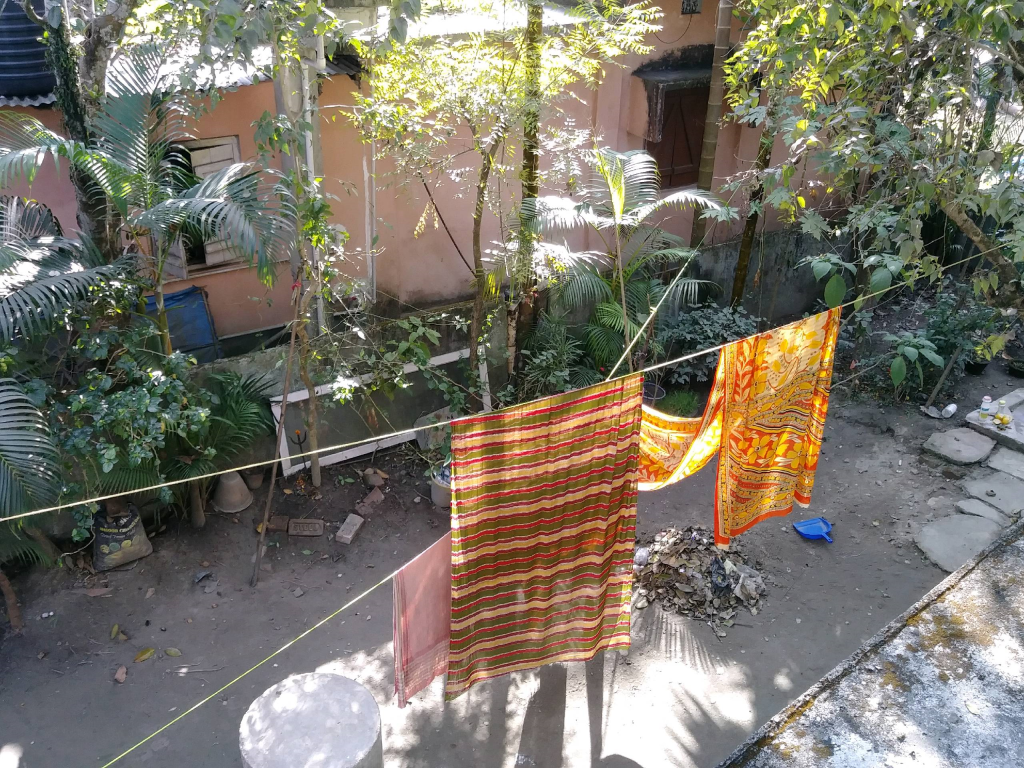
Saris drying in the sun.

I have worn sari before on occasion, but it is very difficult – impossible – to pull it off gracefully when you are accustomed to wearing jeans and tennis shoes.   Also, the petticoat is horribly uncomfortable: since it is the infrastructural element on which the whole thing literally hangs, it has to be cinched very tightly around the waist (and because cotton drawstrings stretch easily, you’re well-advised to start out with that thing really tight or you might soon find yourself adroop!).  Although most women here can easily dress themselves, to get me dressed in a sari takes one if not two assistants!  It reminds me of when my mother tied the bows in the back of my dresses when I was a girl; I hated it so much I would stamp my feet in anger!   To tell the truth, I’ve had to exercise great self-control to prevent myself from doing just that while I’m in the process of being wrapped! Wearing sari for me feels like being in costume – which is basically the case – and I can’t feel comfortable, always afraid something is going to unravel and there I’ll be, exposed in blouse and petticoat. 

But I wonder, what does it mean for me to wear Indian dress here?  What am I saying to myself and to the people around me?  My observation is that people either really don’t notice that much – because what else would a middle-aged woman wear if she’s not wearing sari?  Or maybe they appreciate that I am wearing Indian dress because it somehow implicitly shows respect for the local culture and customs?  Or they are too polite to say – why are you doing that?  Why are you not just wearing jeans and tennis shoes? 

If I were younger (or if I were in a more metropolitan area) I think I would be less likely to wear Indian dress, but I feel it is the appropriate thing to do here, reflecting my age and status.  Coming from the US, where we usually don’t openly recognize status and instead adhere to an ideal (if not a reality) of equality, it is an odd feeling to recognize and acknowledge my own status here, status based on my age, my profession, my position, my education, my relative wealth; and most fundamentally, a status based on something I have nothing to do with and which absolutely eclipses those other markers of status – my race and my nationality – being a white American. As a white woman in the U.S. I already have a great deal of privilege; I sometimes wonder whether being a white American in India – I am “Madam” here – is the closest thing I will ever experience to  being a tall, white male in America: I am noticed, respected, listened to, deferred to – and perhaps occasionally resented.

It’s delicate to find a middle ground between on the one hand acknowledging and understanding my status here, while at the same time, trying to step out of it and bring some of what I see as essentially “American,” to my experience and interactions by transgressing those status boundaries. Of course, it is only due to my privilege that I can try to transgress those boundaries if I so choose. Choto-boro — keeping my dupatta in balance.  The old question, “What should I wear?” carries a lot of freight. 

Black or Red?

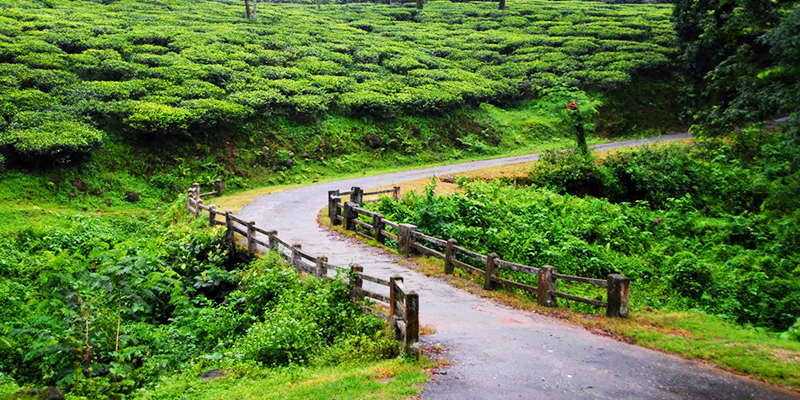
North Bengal is tea country.  Nestled in the foothills of the Himalayas, (sounds awfully romantic, doesn’t it?) the area around the city of Siliguri is dotted with tea gardens, or tea estates, as the plantations where tea is grown are called.  In fact, there are even tea gardens within the city – there’s a small tea garden across from my apartment complex, and the University of North Bengal campus has a large tea garden of its own because it offers a Masters degree in Tea Science.  The tea crop here has just been “plucked” and the bushes pruned – as camellias, they would grow to great heights if not cut back — so the bushes are not as gorgeously emerald green as they usually are. I’ll post a picture later when they are more picturesque. 

Tea Garden
(I didn’t take this pic.)

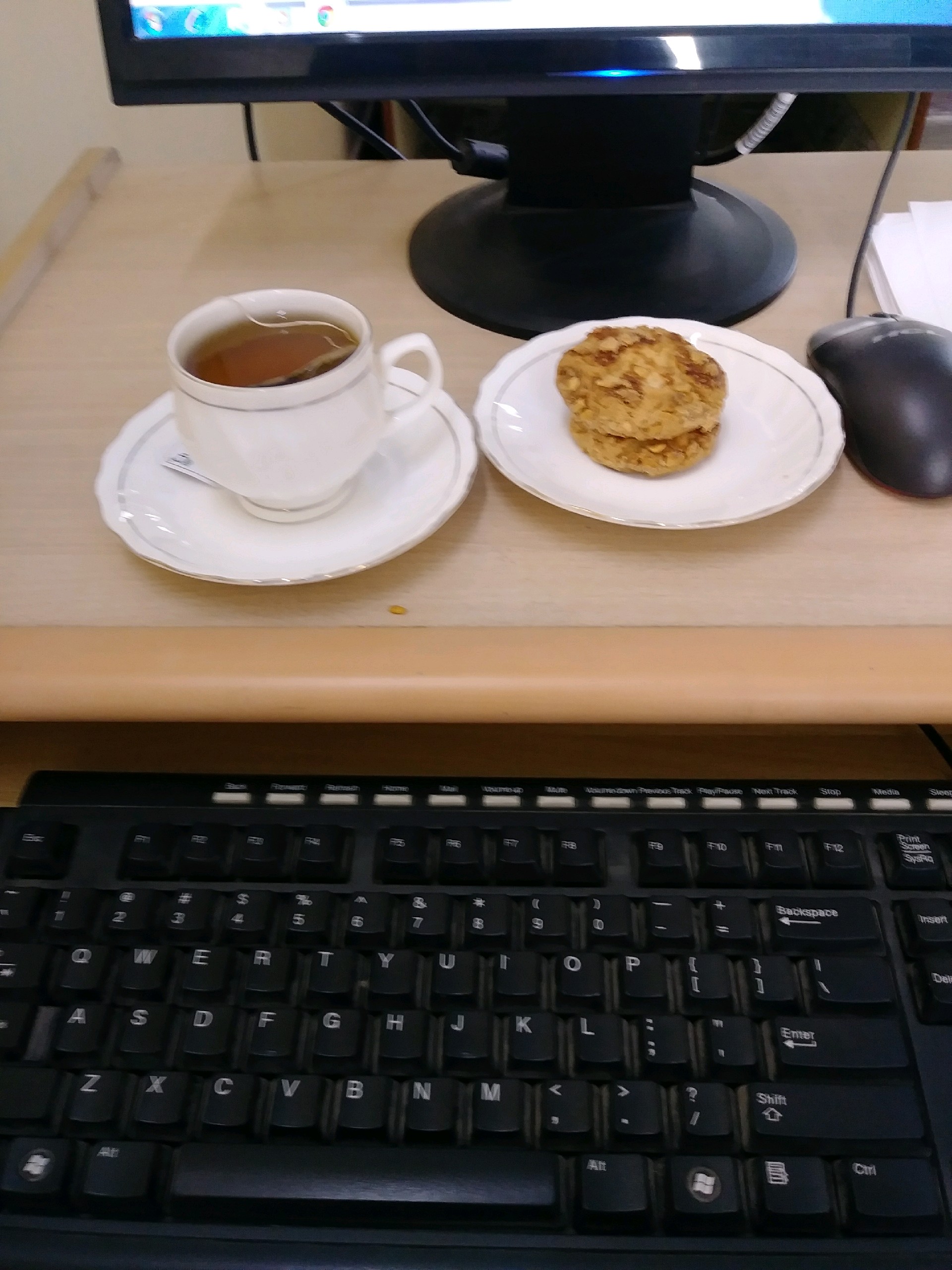
North Bengal is also, like the rest of India, a tea-drinking area.  Several times each day a History Department staffer comes around to my office to ask if I want tea.  It’s been established that I do want tea – no milk, no sugar please. He (remarkably it is a he) brings a small cup of tea along with a plate of “biscuits” (cookies) or namkeen – spicy snacks such as puffed rice with peanuts, roasted chickpeas or roasted mung beans and the like.  Sarbari and Amitabha, who I am staying with while my flat is being painted (I always think of having to flatten myself to a ribbon in order to fit into a “flat”) have a cup of tea and a snack each evening around 7:00 to tide them over until dinner at 10:00.  (Way past my still jet-lagged bedtime!)

Everyone seems to have their own favourite tea estate –hey! the spell-checker just auto-corrected that! – Lopchu, Makaibari, Goldricke, for example.  Those are the first three names that popped into my head, and that is fitting, since they reflect the diversity of this area: Lopchu is a Nepali name, Makaibari a Bengali name and Goldricke, of course, is British. 

China and India are the two main tea producers in the world and each have their own underlying tea culture.  Of course, both claim to produce the very best tea in the world! In China and throughout East Asia most people drink green tea.  Here, people drink “black” tea – except that they call it “red” tea!  Green, black or red, all true tea (as opposed to herbal tea) comes from a variety of camellia, camellia sinensis, a reference to China (Sino).  What makes it different is how long it is fermented after it is picked and before it is dried.  Green tea is picked, then dried right away, whereas black tea is fermented for some period of days before the drying process stops the enzymatic fermentation.  And then there’s oolong tea, which is fermented for an intermediate period, between green on the one hand and black on the other.  (I have just pushed the outer edges of my tea knowledge envelope.) 

So –black tea, red tea!  Which is it?  It all depends – the dried tea leaves are black, the brew they make is red – both are correct.  That’s my insightful insight of the day.